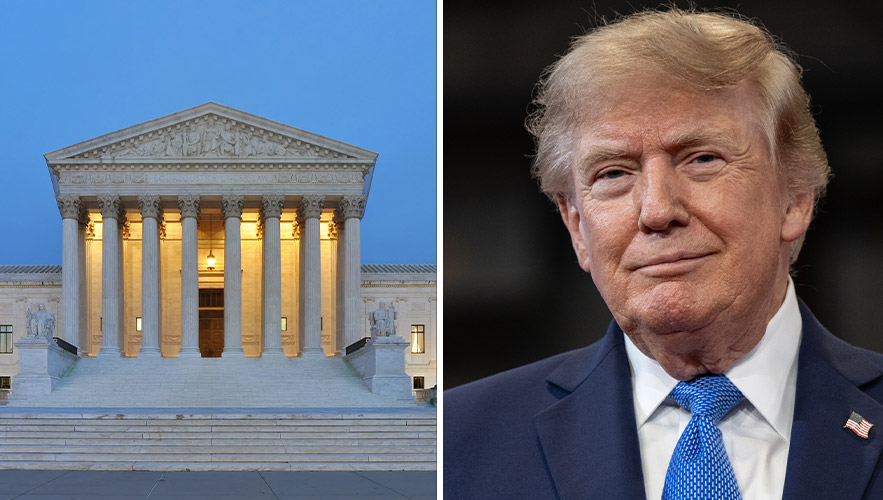
Trump has not declared an election emergency, but his refusal to dismiss the idea comes as his administration expands federal election initiatives and defends executive orders already blocked in court. The most consequential fight is now before the Supreme Court, where a stay request remains pending.
President Donald Trump has spent the summer arguing that U.S. elections remain vulnerable to noncitizen voting and foreign interference, while his administration has released intelligence records, voter-roll analyses and enforcement material to support a broader election-integrity campaign. His July prime-time address brought those themes into unusually prominent national focus.
The debate escalated in August when conservative broadcaster Wayne Allyn Root asked Trump whether he would declare a national security emergency over elections. Trump did not endorse the proposal, but he also did not reject it, replying that “stranger things have happened.” As of Aug. 23, no such emergency had been declared.
Emergency talk is still speculation
Some Trump allies and critics have treated the president’s remarks as a signal of what could come before the Nov. 3 midterm elections. Former Trump strategist Steve Bannon has predicted an emergency declaration. Ty Cobb, a former White House lawyer who is now a Trump critic, told PBS after the July address that he believed the speech was intended to help create a predicate for one.
Those are interpretations, not announced administration policy. The White House has declined to address hypothetical emergency scenarios and instead says its election initiatives are aimed at restoring confidence, enforcing citizenship requirements and persuading Congress to enact additional safeguards.
The strongest version of the concern — that Trump has already decided to nationalize election administration through emergency powers — is not established by the public record. What is established is that his administration has pursued a more expansive federal role, that Trump has left the emergency idea open in public, and that some allies are urging him to act.
In his July address, Trump said his goal was to confront vulnerabilities and make elections more trustworthy. The White House has also assembled an “Election Integrity” page featuring declassified intelligence, voter-roll claims and investigative materials intended to support that case.
An emergency is not a blank check
Even if Trump declared a national emergency related to elections, the declaration itself would not give the president general power to rewrite voting rules across the country.
The National Emergencies Act provides a framework for presidents to declare emergencies and activate specific authorities that Congress has placed in federal law. It requires the president to identify the statutory powers being invoked. It does not create a free-standing presidential authority to suspend the Constitution or take over state election systems.
Federal election administration is divided differently. The Constitution gives states the initial responsibility for setting the “Times, Places and Manner” of congressional elections, while giving Congress authority to alter those rules. The president is not given a comparable general power to dictate election procedures.
An emergency declaration could still trigger real federal authorities in other areas, so litigation would turn on the particular statutes invoked and actions ordered. Any effort to use federal personnel or executive resources at polling places would face additional statutory and constitutional constraints. The central question would be what power Congress actually granted.
Courts have already limited Trump
The legal boundaries are not hypothetical. Federal judges have already blocked important parts of Trump’s election-related executive actions.
In March 2025, Trump signed an election order that sought documentary proof of citizenship on the federal voter-registration form and changes affecting mail ballots. A federal judge in Washington later preliminarily blocked key provisions, concluding that the Constitution assigns election-regulation authority to states and Congress rather than giving the president an independent lawmaking role.
In June 2026, a federal court in Massachusetts permanently enjoined major provisions of that 2025 order as applied to the states and jurisdictions before it. The ruling did not establish that a president can never take any action touching elections. It reinforced a narrower principle: executive orders need a valid constitutional or statutory foundation.
Those cases matter to emergency speculation because changing the label on an executive action would not automatically cure the underlying separation-of-powers problem. An emergency declaration can activate powers Congress has granted. It cannot, by itself, manufacture an election power Congress never delegated.
A second order faces a bigger test
Trump’s newer election order, signed March 31, 2026, has created an even more immediate legal fight.
Executive Order 14399 directs the Department of Homeland Security and Social Security Administration to help compile state-specific citizenship lists using federal databases and send them to states before federal elections. It also directs the Postal Service to develop new election-mail procedures and contemplates restrictions involving absentee or mail ballots from voters who are not on specified state lists.
The order also tells the attorney general to prioritize investigations and prosecutions involving ballots allegedly issued to ineligible voters. Supporters describe those steps as enforcement tools; opponents argue that the order intrudes into election administration without congressional authorization and could wrongly flag eligible citizens.
On June 25, a federal district court in Massachusetts blocked key provisions in 23 plaintiff states and the District of Columbia through the Nov. 3 election. The First U.S. Circuit Court of Appeals later declined to pause that injunction.
The administration then asked the Supreme Court for emergency relief. Trump v. California was docketed July 27, with briefs filed in early August. As of Aug. 23, the Supreme Court docket showed no order resolving the government’s stay request, making that application one of the most concrete election-power disputes to watch.
Voter-roll numbers need qualification
The administration has leaned heavily on estimates of noncitizens appearing on voter rolls, but its most prominent figures require careful reading.
In July, Trump cited a Department of Homeland Security review that the White House said had identified about 278,000 noncitizens registered in California, Nevada, Pennsylvania and New Jersey. Subsequent information from Nevada showed why such topline numbers should not be treated as completed findings of illegal voting.
Nevada officials initially received a figure of 15,903 potential noncitizens. By mid-August, DHS had manually reviewed a much smaller subset and said 185 had been confirmed as noncitizens. Thousands of other records remained under review. A noncitizen match also does not prove that the person cast an illegal ballot.
Timing can create errors: someone may appear in an older immigration database as a noncitizen and later become a naturalized citizen. Large-scale data matching can also produce false positives when records are incomplete or identifiers do not align cleanly.
There are genuine administrative failures. New Jersey disclosed this summer that about 6,600 noncitizens had been mistakenly registered because of a motor-vehicle agency software problem, and fewer than 400 cast ballots. That episode warrants investigation, but it does not establish that the administration’s larger estimates are accurate.
Census analysis is preliminary
A separate Census Bureau analysis released in August added another disputed number: more than 24,000 records associated with people the bureau classified as noncitizens in the 2020 election.
The report is explicitly an initial analysis. It says more than 128 million records were classified as citizens, more than 24,000 as noncitizens and more than 32 million remained to be analyzed. The bureau used a commercial voter file and federal administrative data, then linked records using internal identifiers.
The report does provide a short methodological appendix, contrary to claims that no methodology was disclosed. What it does not provide is enough detail for outside researchers to calculate the false-positive rate or fully validate each match.
Election specialists interviewed by the Associated Press said the analysis does not prove that 24,000 noncitizens illegally voted. The conclusion depends on the accuracy of the commercial voter file, federal citizenship records and the record-linkage process. A database match is not the same as an individualized eligibility determination.
Twenty-four thousand is roughly 0.015% of the nearly 158.4 million presidential votes cast in 2020. The bureau’s preliminary state counts were below the presidential margin in every state. None of that makes an illegal vote acceptable; it does mean the report does not substantiate Trump’s false claim that the 2020 presidential election was stolen.
Congress remains the clearest route
Trump has simultaneously pushed Congress to pass the SAVE America Act, legislation that would impose new federal requirements involving proof of citizenship, voter identification and voter-roll maintenance.
The House passed the measure in February by a 218-213 vote. The Senate, where most legislation still needs 60 votes to overcome a filibuster, left Washington for its summer recess without passing it. Senators are scheduled to return in September, leaving the proposal unresolved rather than enacted law.
That path is constitutionally important. Congress has broad authority to regulate federal elections, subject to other constitutional protections, while the president’s ability to alter election procedures on his own is much narrower. New rules enacted by Congress therefore present a different legal question from comparable changes attempted through unilateral executive action.
The White House says the bill would help ensure only citizens participate in federal elections and argues Democratic opposition undermines public confidence. Voting-rights groups and Democratic officials say documentary requirements can burden eligible citizens and that evidence does not show widespread noncitizen voting.
The dispute is therefore partly about policy and partly about evidence: how large a problem has actually been demonstrated, and which branch has the lawful power to address it.
What matters before November
The most important developments before the midterms will be concrete ones, not predictions.
The Supreme Court could act on the administration’s request to revive portions of the March order. Congress could revisit the SAVE America Act after the Senate returns. Federal agencies may release more election-integrity material, while states continue reviewing voter-roll matches and preparing their own procedures.
An emergency declaration, if Trump ultimately issues one, would create a major constitutional confrontation, but it would not settle that confrontation in the president’s favor. Courts would likely be asked quickly to examine the statutes invoked and actions ordered. Trump’s previous election directives show that judges are willing to scrutinize whether presidential action exceeds delegated authority.
For now, the public record supports two conclusions at once. Trump and his administration are making an unusually aggressive push for greater federal involvement in election security, and the president has declined to rule out an emergency declaration. But no election emergency has been declared, and neither the National Emergencies Act nor the Constitution gives the president automatic power to take national control of voting.
That distinction will matter if rhetoric becomes action. So will the evidence used to justify any new step. Preliminary database matches, genuine but limited registration errors, declassified intelligence about vulnerabilities and political claims about 2020 are not interchangeable. Each carries a different evidentiary weight, and any effort to change the rules for November would face scrutiny on both facts and law.
Leave a Reply