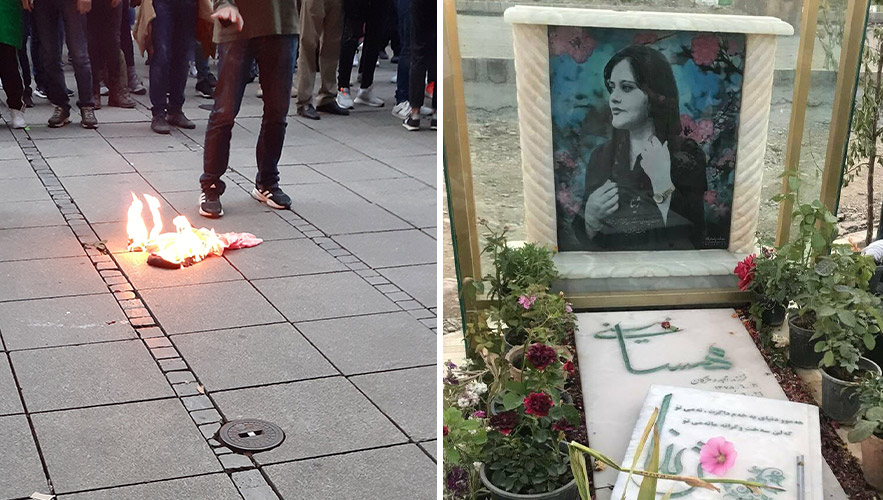
Iran’s renewed push to enforce compulsory hijab is colliding with a social reality transformed by the 2022 “Woman, Life, Freedom” uprising. Authorities are closing businesses and threatening prosecutions, but the harsher 2024 law remains suspended while widespread public defiance continues.
Four years after Mahsa Amini’s death in morality-police custody triggered nationwide protests, Iran’s leadership is again testing how far it can push compulsory veiling without provoking another confrontation. A United Nations fact-finding mission later concluded that Amini was subjected to physical violence that led to her death in custody and that the Iranian state bore responsibility for her unlawful death. Iranian authorities have disputed allegations that police violence caused her death.
The pressure has become more visible in recent weeks. Prosecutors have warned cafes, restaurants and clothing stores over alleged violations of “public chastity,” while businesses in several cities have been sealed over failures to enforce dress rules. Yet women without headscarves remain a common sight in parts of Tehran and other large cities, underscoring the widening gap between the law on paper and everyday behavior.
Enforcement is returning indirectly
The newest campaign is not simply a revival of the street patrols that became a symbol of state coercion after Amini’s death. Much of the pressure is being applied through businesses, prosecutors and administrative controls.
Tehran Prosecutor Ali Salehi said authorities would act against cafes, restaurants and clothing sellers accused of violating public-morality rules. Iran International reported that he later ordered judicial officials to identify what he called “organized and networked actors” promoting unveiling. Recent closures have affected cafes, restaurants, shops and sports clubs in more than 15 cities.
Iranian media also reported the creation of a specialized prosecutor’s office in Tehran dealing with “moral security” cases, including hijab violations and other alleged offenses against public morality. The move adds another institutional channel for enforcement even without a blanket return to intensive morality-police patrols.
CNN, citing the Human Rights Activists News Agency, reported that at least seven cafes and restaurants in Tehran were closed on July 19 over alleged failures to enforce mandatory hijab. In South Khorasan Province, the Mehr news agency reported that 10 cafes had been shut over alleged violations of social norms and hijab rules.
That approach shifts some of the burden from police directly confronting women to private businesses that risk being sealed if customers or staff do not comply. Human Rights Watch has documented business closures, vehicle impoundments, prosecutions and digital surveillance as tools for enforcing compulsory hijab even while authorities have reduced some highly visible arrests.
A stricter law remains suspended
Iran’s basic compulsory-veiling rule has not disappeared. Article 638 of the Islamic Penal Code provides penalties for women who appear in public without what the law calls “Islamic hijab.” The provision does not precisely define what constitutes a proper hijab, leaving substantial discretion to authorities.
The more sweeping “Hijab and Chastity” law is a separate measure. Finalized in 2024, it was designed to expand penalties, surveillance and enforcement responsibilities. But the Supreme National Security Council blocked its implementation, and the suspension remains in effect.
That distinction matters because political rhetoric can make the current enforcement drive sound as though the full 2024 law has been activated. It has not. Human Rights Watch said in its 2026 Iran report that the law was suspended but not repealed, while older compulsory-hijab laws and enforcement mechanisms remained in force.
Hardliners have repeatedly demanded that the tougher measure be implemented. Parliament Speaker Mohammad Bagher Ghalibaf disclosed in May 2025 that the Supreme National Security Council had instructed parliament not to promulgate it for the time being. Iranian officials have continued to say that decision has not been reversed.
Defiance survived the 2022 crackdown
Amini, also known by her Kurdish name Jina, was 22 when morality police detained her in Tehran in September 2022 over an alleged hijab violation. Her death three days later helped ignite the “Woman, Life, Freedom” movement, which rapidly became a broader challenge to the Islamic Republic’s political and social order.
The UN fact-finding mission found that the state response involved grave human-rights violations, including killings, arbitrary detention, torture and sexual violence, and concluded that some violations amounted to crimes against humanity. The mission identified structural discrimination against women and girls as an important underlying factor in the abuses.
The protests were suppressed, but compulsory veiling never fully returned to its previous social position. In major cities, increasing numbers of women continued appearing in public without headscarves. By 2025, Radio Farda reported that women in multiple Iranian cities described unveiled public life as increasingly normalized.
That change is central to the government’s current dilemma. A rule can remain legally enforceable while becoming harder to impose socially, especially when large numbers of people openly ignore it and when enforcement itself risks reviving memories of the unrest that followed Amini’s death.
Hardliners frame hijab as loyalty
For conservative clerics and politicians, the dispute is not being presented merely as a question of clothing. It is increasingly tied to national identity, religious legitimacy and political loyalty.
State-aligned voices have described widespread unveiling as “nudity,” “public vice” or an organized effort to erode Islamic values. Tehran Friday prayer leader Mohammad Javad Haj Ali Akbari has alleged that some people are paid to appear publicly in clothing authorities consider improper. No publicly established evidence shows that widespread noncompliance is a paid operation.
At pro-hijab gatherings, the rhetoric has sometimes gone further by linking unveiling to Iran’s foreign enemies. One placard displayed at a gathering in Isfahan attributed to Israeli Prime Minister Benjamin Netanyahu the line, “Unveiled women are our free soldiers.” There is no verified record that Netanyahu made that statement.
The slogan nevertheless illustrates how some hardliners are trying to recast domestic civil disobedience as a security issue. That framing is especially significant during Iran’s conflict with the United States and after the leadership transition that placed Mojtaba Khamenei, son of the late Ali Khamenei, in the position of supreme leader. Reuters reported that the Assembly of Experts selected Mojtaba Khamenei in March.
War has complicated the crackdown
Iran entered 2026 under extraordinary pressure. The United States and Israel launched strikes on February 28, killing Supreme Leader Ali Khamenei, and the ensuing conflict has imposed heavy military and economic costs. Iran is also dealing with sanctions, disrupted oil exports and continuing disputes with Washington over the Strait of Hormuz.
During periods of acute military confrontation, the government had incentives to emphasize national unity rather than provoke a fresh internal fight over women’s clothing. CNN reported that unveiled women appeared at some pro-government gatherings and in state media during the height of the conflict.
As the intensity of fighting has fluctuated, the hijab issue has returned to the foreground. That does not mean the government has resolved its internal argument over enforcement. President Masoud Pezeshkian has previously questioned whether behavior and belief can be changed through coercion or legislation, while hardliners have continued demanding tougher action.
The political calculation is difficult. Aggressive street enforcement risks reviving the imagery and grievances of 2022. Doing too little, however, invites accusations from hardliners that the state is abandoning one of the Islamic Republic’s defining social rules.
Artists remain vulnerable
The case of singer Parastoo Ahmadi shows that reduced street enforcement does not mean cultural defiance is consequence-free.
Ahmadi drew international attention after livestreaming a 2024 performance in which she sang without a headscarf. In June 2026, a criminal court in Qom issued a first-instance ruling sentencing Ahmadi and eight musicians and production-team members to 74 lashes, a two-year travel ban and a two-year ban on artistic activity.
Reports on the verdict said the defendants were accused of offenses involving public decency and publishing content authorities deemed vulgar or immoral. Importantly, the ruling remained subject to appeal. Describing the punishment without that procedural qualification would risk presenting a preliminary judgment as final.
The case also shows how hijab enforcement overlaps with restrictions on artistic expression, online publication and women’s public performance. Authorities do not need a mass morality-police deployment to exert pressure when courts, licensing bodies, online controls and venue closures can produce other forms of deterrence.
Rights groups see a wider system
International rights organizations have argued that compulsory veiling is enforced through an interlocking system rather than a single police unit.
Amnesty International said in 2024 that authorities had intensified what it called a “War on Women” through surveillance, arrests, beatings and other abusive treatment aimed at women and girls defying compulsory veiling. Its reporting followed the launch of the “Noor Plan,” a nationwide enforcement campaign.
The UN fact-finding mission has described Iran’s compulsory-hijab laws and practices as discriminatory and documented penalties including detention, fines, property seizures, travel bans, employment consequences and restrictions on access to education and social media.
Human Rights Watch’s 2026 assessment similarly said authorities continued prosecuting women and girls, closing businesses and using digital surveillance even as officials reduced some violent arrests in larger cities. That combination of restraint and coercion helps explain why the present moment can look contradictory: women appear more visibly unveiled while the state retains numerous ways to punish them.
The state faces a changed society
One revealing front is the fight over motorcycles. Iranian media and social posts have shown women riding scooters and motorbikes, often wearing helmets but no headscarves. Iran International reported that women were still being denied motorcycle licenses despite a government decision sent to police in February.
The dispute shows how the struggle over compulsory veiling spills into mobility and public space. Women are testing boundaries not only by uncovering their hair but by entering activities long restricted in practice. Each visible change makes a full return to pre-2022 norms harder to impose without a much larger enforcement effort.
The key question is therefore no longer whether Iran has compulsory-hijab rules. It does. The question is how much enforcement the state can impose without creating political costs greater than the behavior it is trying to stop.
For many women, especially those who came of age around the 2022 uprising, appearing in public without a headscarf has become an ordinary act as well as a political one. Reversing that shift would require more than restoring a patrol or opening another prosecutor’s office. It would mean forcing a broad social retreat that authorities have so far been unwilling or unable to achieve.
That helps explain the current pattern: selective prosecutions, pressure on businesses, official warnings and cultural campaigns alongside hesitation about a sweeping street crackdown. The state is enforcing enough to signal that compulsory hijab remains policy, but not yet at the scale hardliners are demanding.
The balance could still change. Iran’s leadership is operating amid war, sanctions, economic stress and a reconfigured power structure under Mojtaba Khamenei. In that environment, hardliners may continue pressing to treat unveiling as both a religious offense and a challenge to state authority.
But four years after Amini’s death, the government is confronting a reality produced partly by the crackdown itself. The “Woman, Life, Freedom” uprising did not overturn the compulsory-hijab system, yet it transformed public behavior in ways that have proved difficult to reverse. The renewed enforcement drive is therefore not a return to the old status quo. It is a test of whether the state can recreate one.
Leave a Reply