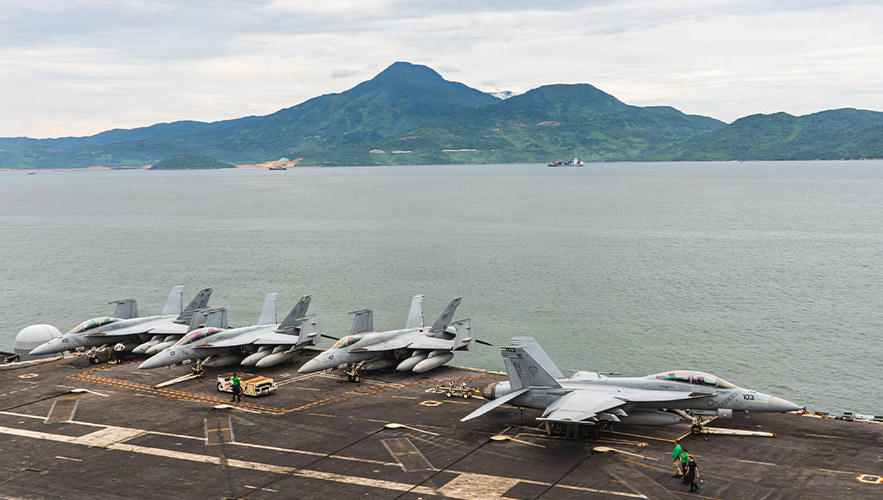
The carrier is finally leaving the Middle East after a deployment stretched by the Iran war. But for families who describe missed milestones, supply problems and mounting stress, the relief comes with anger over senior officials’ public dismissal of their concerns.
The USS Abraham Lincoln is leaving the Middle East after a nine-month deployment that became one of the most closely scrutinized Navy missions of the Iran war. The USS George Washington has arrived in the region to relieve it, and a U.S. official told CBS News the Lincoln’s sailors and Marines are heading home.
That answers the question families had asked for months — when their loved ones would return — but it does not settle the dispute over conditions aboard the carrier. Relatives interviewed by USA TODAY say the prolonged deployment carried a physical and emotional cost that government leaders too often minimized.
Relief has finally arrived
The Lincoln left San Diego on Nov. 21, 2025. By Aug. 14, Acting Navy Secretary Hung Cao said it had been deployed for 266 days, including 200 days in a combat zone, and had launched more than 10,000 sorties while expending 1.5 million pounds of ordnance. The Iran war turned a conventional deployment into a longer, higher-tempo mission.
The carrier also went more than 250 days without a port call, according to USNI News, a punishing stretch that limited sailors’ time off the ship and complicated resupply and maintenance. Operations continued while the crew lived in a confined environment under wartime restrictions.
The George Washington entered the U.S. Central Command area in mid-August and was operating in the Arabian Sea by Aug. 20. CBS News reported that the Lincoln was leaving the Middle East and could take roughly three weeks to reach San Diego.
For relatives, the change in carriers means an end is finally visible after months of changed expectations, missed family events and uncertain return dates.
Families describe the personal cost
Tameka Kyles told USA TODAY that her sister, a senior machinist aboard the Lincoln, expected to be home in time for her son’s graduation from Morehouse College. Instead, the sailor was still at sea as the ceremony approached, worried unreliable internet might prevent her from even seeing photographs.
Kyles said her sister had joined the military in part to build a better life for her son. Missing his graduation therefore was not simply another inconvenience of deployment. It was the loss of a milestone that had helped give years of service and sacrifice a personal purpose.
Cristi McGarey described a similar disruption. Her 22-year-old son, who has worked as a cook and later in the carrier’s shipping department, expected to return in time for his sister’s June wedding in Colorado. The family kept hoping he might somehow appear. He did not.
Those missed events explain why some families reacted so sharply to President Donald Trump’s comments. The argument was not merely over whether sailors could continue performing their missions. It was also over whether the costs borne by sailors and relatives were being acknowledged.
Reports focused on daily conditions
Family accounts gathered by USA TODAY and reports from military publications described problems ranging from food quality and unreliable package delivery to shortages of hygiene items, broken plumbing and limited communication with home. Kyles said her sister lost roughly 10 to 15 pounds and at times ran out of soap or laundry detergent.
McGarey said her son described periods without hot water and toilets that remained broken too long. She also said he discouraged her from sending packages because mail was taking so long to arrive. Sen. Richard Blumenthal, D-Conn., later cited reports of food, clean-water, hygiene and mail problems while seeking answers from Pentagon leaders.
Not every allegation has been independently established, and the Navy has disputed the broadest descriptions of a ship in crisis. Family testimony documents what relatives say sailors told them and what they observed in messages, calls and photographs; it does not prove every reported problem was shipwide or continuous.
Still, the Navy’s own statements acknowledge unusual strain. Cao said meal plans were adjusted when fresh resupply was unavailable and calls home were limited when the operational threat was too high.
Trump and Hegseth pushed back
Pentagon chief Pete Hegseth said on Aug. 13 that reports about deteriorating conditions had been “completely misrepresented.” Speaking during a trip to Panama, he said military leaders try to provide every ship and crew with what they need, while noting that some deployments are longer and more austere than others.
Trump went further the next day. Asked about family concerns over conditions aboard the Lincoln, he rejected the premise. Asked whether the deployment had gone on too long, he said, “No. Not nearly long enough.” Reuters and the Associated Press both reported the remarks.
For families already tracking missed weddings, graduations, delayed packages and irregular calls, those comments landed as a denial of lived experience. Kyles told USA TODAY that her immediate reaction was to ask how administration leaders would feel if their own families were aboard the carrier.
The White House, responding to USA TODAY, did not directly address relatives’ individual accounts. Spokesperson Anna Kelly said Trump had restored a focus on readiness and supporting warfighters and was ensuring service members had the resources needed for the mission against Iran.
Navy leaders acknowledge strain
.jpg)
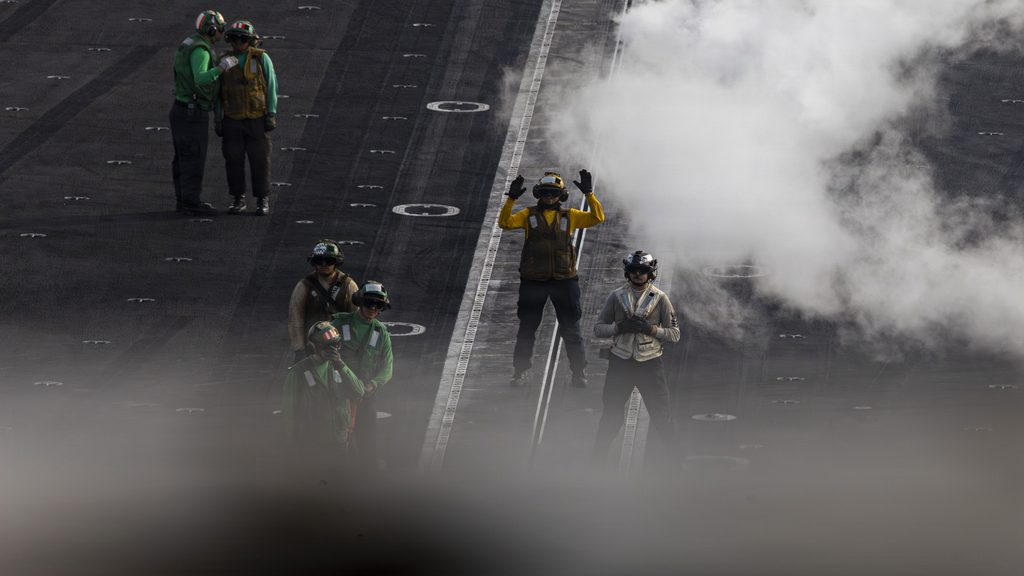
The official response has not been a claim that nothing was difficult. Cao’s Aug. 14 statement defended the deployment while saying the Lincoln’s sailors and Marines had been “pushed to their limits” and were “rightly tired.” He framed that hardship as part of combat operations rather than evidence the crew had been abandoned.
Cao said no meals had been missed despite adjustments in fresh-food availability and that a small number of mental-health cases had been treated with no loss of life. He rejected coverage that, in his view, portrayed the crew as victims instead of recognizing its performance.
Adm. Brad Cooper, head of U.S. Central Command, visited the carrier and praised the crew’s resilience. Reuters reported that Cooper said the Lincoln had the lowest number of mental-health cases among the Navy’s 11 active aircraft carriers.
Those claims are important context, but they do not necessarily resolve the families’ complaints. A carrier can remain operational, complete combat missions and post favorable aggregate statistics while individual sailors still experience shortages, stress, family separation or deteriorating morale.
Mental-health claims remain disputed
The most serious disagreement concerns reports that sailors had tried to go overboard. Military publications reported multiple incidents or attempts, raising alarm about mental health on the ship. U.S. Central Command pushed back, saying one sailor fell overboard on Aug. 3 and was quickly and safely recovered.
CENTCOM also said no service member aboard the carrier had died and criticized what it called rampant misreporting. The Navy has said it did not see an increase in reported suicide attempts or suicidal ideation aboard the Lincoln and was investigating the Aug. 3 incident.
That leaves a gap between some accounts from sailors and families and what military officials say their records show. The evidence supports reporting the dispute, not turning it into certainty that multiple suicide attempts occurred or certainty that every family concern was unfounded.
The broader issue is less disputed. Even Navy leadership has acknowledged extraordinary fatigue and stress. Months in a combat zone, repeated extensions, limited port access and uncertain communication create conditions in which resilience and strain can exist at the same time.
Congress wants a fuller accounting
The controversy has moved beyond family group chats and military news coverage. Blumenthal, a member of the Senate Armed Services Committee, asked Hegseth and Cao for a formal accounting of conditions aboard the ship, including fatigue, morale, supply problems, water and plumbing issues, mail disruptions and mental-health resources.
A larger group of Democratic senators, joined by independent Sen. Angus King of Maine, also sought answers and requested permission for a bipartisan congressional delegation to visit the carrier. Their questions include how the Navy measures crew well-being during extended deployments and how it plans to prevent similar problems.
The Pentagon and Navy say the Lincoln’s extension was driven by wartime requirements and that the George Washington’s relief mission was part of a planned rotation. That explains why the carrier remained in theater, but lawmakers are also asking whether the Navy had enough logistical and personnel capacity to sustain the mission without excessive strain.
That question reaches beyond one ship. Carriers can be replenished underway, but prolonged combat operations without normal port access increase pressure on food supply, maintenance, communications, medical support and crews.
The next carrier inherits the mission
The George Washington’s arrival solves one immediate problem: it allows the Lincoln to leave. It does not end U.S. carrier operations tied to the Iran conflict, and families and lawmakers are already asking whether the replacement crew could face similar pressures if the mission remains prolonged.
USNI News reported that the George Washington moved from the Indo-Pacific into the Central Command theater with accompanying warships. Its arrival shows the Navy rotating forces rather than leaving the Lincoln in place indefinitely, but it also demonstrates how a long conflict can create demands across multiple fleets.
Blumenthal told USA TODAY he was not yet convinced the Navy had substantially improved the supply routes and support systems that would serve the George Washington. That concern is prospective, not proof the replacement carrier will experience the same conditions.
The test will be whether the Navy can preserve operational readiness while giving the new crew more predictable resupply, maintenance, communication and relief.
Homecoming will not end questions
For the Lincoln’s crew, the most important development is straightforward: the carrier is heading home. After more than nine months away, the sailors and Marines who carried out thousands of combat sorties are finally moving toward San Diego and their families.
But the homecoming is likely to sharpen, rather than erase, questions about the deployment. Families will be able to hear fuller accounts from sailors outside the constraints of unreliable communications and an active combat mission. Lawmakers will continue pressing the Pentagon for records and explanations.
The administration’s position is that the crew remained effective, was supplied sufficiently to perform its mission and has been unfairly portrayed as broken. Families speaking publicly are making a different point: mission accomplishment does not cancel out hardship, and acknowledging hardship does not diminish the sailors who endured it.
That is why Trump’s and Hegseth’s words became such a large part of the story. The dispute was never only about how many days a carrier can remain at sea. It was about what leaders owe service members when those days stretch into months — and whether families who watched the toll from home felt heard.
The Lincoln’s departure closes the longest chapter of that deployment. The argument over what happened aboard it, how the Navy handled the strain and what should change before another crew faces the same test is only beginning.
Leave a Reply