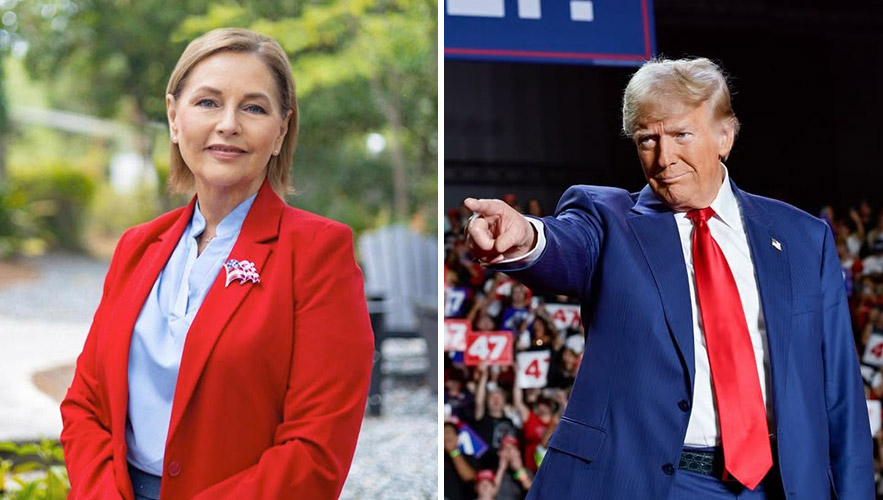
Donald Trump has invested far more than a routine endorsement in Darline Graham’s bid for a full Senate term, making Tuesday’s runoff an unusually direct test of his ability to move Republican voters when he is not on the ballot. A loss would sting politically, but it would not by itself prove his influence has collapsed.

South Carolina Republicans are deciding Tuesday whether Graham, the late Sen. Lindsey Graham’s sister and appointed successor, or Rep. Ralph Norman will become the party’s Senate nominee for November. Polls close at 7 p.m. Eastern, and the winner will face Democratic nominee Annie Andrews.
The contest is unusually compressed. Lindsey Graham died July 11 after already winning the Republican nomination for another term. Gov. Henry McMaster appointed Darline Graham on July 13 to fill the Senate vacancy, and she was sworn in the next day. The state then scheduled a special Republican primary to select a replacement nominee for the November ballot.
Why Trump made it personal

Trump did not simply post an endorsement and move on. He encouraged Darline Graham to run for a full six year term, traveled to Myrtle Beach for a campaign rally Friday and held a tele rally for her Monday night. His allied super PAC, MAGA Inc., also poured more than $827,000 into calls and text messages aimed at turning out voters for her.
At the Myrtle Beach rally, Trump made the stakes explicit. He told supporters to “pretend, please, that I’m on the ballot,” acknowledging a recurring Republican concern: voters who turn out enthusiastically for Trump in presidential elections do not always show the same enthusiasm when he is absent.
Trump also said he had personally urged Graham to enter the race. Darline Graham was not an established statewide political candidate before her appointment. She had spent much of her career in disability services and, since 2019, had led the South Carolina Commission for the Blind.
That makes the runoff different from a typical endorsement test. If Graham wins, Trump can argue that he helped turn a political newcomer into the nominee for a Republican leaning Senate seat. If she loses after that level of involvement, the defeat would be harder to dismiss as the failure of a candidate he barely supported.
What the first round showed
Graham entered the runoff from a position of strength, but not dominance. In the Aug. 11 special Republican primary, she finished first with 32.7% of the vote, or 109,633 votes. Norman placed second with 24.6%, or 82,541.
Rep. Russell Fry finished third with 19.6%, and former Gov. Mark Sanford took 14.9%. Because no candidate reached 50%, Graham and Norman advanced to Tuesday’s runoff.
Those numbers create competing interpretations. Graham supporters can point out that she led a 10 candidate field despite never having run for office before. Norman’s camp can point out that roughly two thirds of Republican primary voters chose someone else, leaving a large pool of voters available in the head to head race.
Fry, Sen. Tim Scott and other prominent Republicans backed Graham during the sprint to the runoff. Norman assembled his own conservative coalition, including endorsements from former South Carolina Gov. Nikki Haley, former Gov. Mark Sanford, former Sen. Jim DeMint and Sens. Rick Scott and Mike Lee.
Why Norman is a real threat
Norman is not running as an anti Trump Republican. That distinction is central to the race.
The five term House member belongs to the Freedom Caucus and has supported many of Trump’s policy priorities. His argument is that Republican voters do not need to choose Graham to support the president’s agenda. He has emphasized his record in Congress, business background and conservative credentials while portraying Graham as untested.
Norman does carry a political mark Trump’s team has highlighted: he endorsed Nikki Haley in the 2024 Republican presidential primary. Graham’s allies have used that decision to question his loyalty, while Norman argues that his congressional voting record is the better measure of where he stands.
That makes the runoff a harder test of endorsement power than a race against a clearly anti Trump opponent. A Norman victory would not necessarily mean South Carolina Republicans rejected Trump’s policies. It could mean enough voters preferred a familiar conservative lawmaker even after Trump personally asked them to choose someone else.
Republican strategist Matthew Bartlett, a former Trump State Department appointee, told Politico that a Graham defeat would be a “massive, massive embarrassment” and an “utter rejection.” Those are political judgments, not measurable facts, but they capture the high expectations Trump created for himself.
Graham’s inexperience became the issue
The clearest vulnerability for Graham has been experience, especially after an Aug. 18 debate in which she was asked about Taiwan and the South China Sea.
Graham said she was “not that informed on national security” and later described national security as outside her area of expertise. The comment drew criticism because senators vote on military policy, nominations and foreign affairs, and because Lindsey Graham had made national security a defining part of his career.
She later acknowledged that she had stumbled on the question and argued that voters she met were more concerned about groceries, gasoline and health care costs. Trump defended her response as honest and said national security was an area in which he could help.
Graham has tried to turn her lack of electoral experience into an outsider argument. At the Myrtle Beach rally, she said critics were correct that she was not a politician and compared her position with Trump’s own first presidential campaign, when he had never held elected office.
Norman has taken the opposite view, arguing that his years in Congress give voters a clearer record to evaluate. His campaign has repeatedly framed experience as an advantage rather than evidence that he belongs to the political establishment.
Trump’s money raises the stakes
The financial intervention by MAGA Inc. is one of the clearest reasons the result will be read nationally.
The pro Trump super PAC reported more than $827,000 in spending on voter contacts for Graham in the final stretch. The expenditure is notable because the group has been sitting on a large cash reserve while Republican candidates in competitive general election races await more help ahead of November.
The spending does not guarantee a result. Get out the vote calls and texts can help identify supporters and remind them to vote, but their effectiveness depends on turnout, organization and the electorate that actually appears.
Still, the decision shows that Trump’s political operation saw the runoff as worth a major late investment. It also means the race will be judged differently from contests in which Trump issued an endorsement but invested little time or money.
The Washington Post reported Tuesday that Trump backed candidates have lost at least 10 primary races this year. Those defeats vary in circumstances and cannot all be treated as equivalent evidence of declining influence. South Carolina is more revealing because Trump escalated his involvement when Graham’s nomination appeared uncertain.
What a Graham loss would mean
A Norman win would be a clear setback for Trump’s claim to be the decisive Republican kingmaker, especially in a state he has carried comfortably and where his endorsement remains valuable in GOP politics.
It would show there are limits to what even an intensive presidential intervention can accomplish when Republican voters have concerns about a candidate’s experience or prefer another contender who also presents himself as strongly conservative.
It could also encourage candidates in future Republican primaries to conclude that defying Trump’s preferred choice is survivable under the right conditions. Norman’s campaign has tested whether a candidate can remain aligned with much of Trump’s agenda while asking GOP voters to disregard Trump’s endorsement.
But one runoff cannot establish that Trump has permanently lost control of the Republican electorate. Turnout in special elections is often low, and this contest was organized on an unusually short timetable after Lindsey Graham’s death.
About 45,000 ballots had already been cast before Election Day, according to the Associated Press. South Carolina also restricts participation in this special Republican process based on earlier primary participation, further shaping the electorate. Those factors make the result politically meaningful without turning it into a national referendum.
What a Graham win would show
A Graham victory would give Trump a strong counterargument to claims that his endorsement power is fading.
He could point to a candidate who began with little electoral experience, faced an established House member and survived intense scrutiny before winning after Trump stepped in personally. The endorsement, rally, tele rally and super PAC spending would allow his team to claim a direct role.
That would matter as Republicans head toward November with control of Congress at stake. Trump has repeatedly argued that his voters need to participate even when he is not running, and the Myrtle Beach rally showed he understands the turnout problem his party faces in midterm and special elections.
A win would not prove that Trump can transfer his coalition everywhere. South Carolina is strongly Republican, Graham carries one of the state’s best known political names, and she also has support from major Republican figures beyond Trump.
Still, winning after making himself part of the ballot choice would strengthen Trump’s leverage inside the party. Candidates deciding whether to seek his endorsement or resist his preferred candidate would have fresh evidence that his intervention can matter.
What to watch tonight
The first question is simply who wins, but the margin and geography will help explain why.
The Associated Press identified Greenville, Richland, Charleston, Horry, Lexington and Spartanburg as key counties. Greenville is especially important because Norman has concentrated effort there, while Horry County includes Myrtle Beach, where Trump staged Friday’s rally for Graham.
Turnout is another major variable. Roughly 3.4 million South Carolinians are registered to vote, but this is a special Republican runoff in late August after voters have already returned repeatedly for primaries. Low participation can magnify highly motivated activists and local political networks.
South Carolina provides for an automatic recount if the final margin is 1 percentage point or less. Until enough ballots are counted to make the outcome clear, neither side can safely claim the race has settled the larger argument over Trump’s influence.
The winner will face Andrews in November. Republicans begin with a substantial structural advantage in a state where Democrats have not won statewide office in two decades, but the general election remains a separate contest with a broader electorate.
For Trump, Tuesday’s immediate test is narrower and more personal. He asked South Carolina Republicans to behave as though his own name were on the ballot. By doing so, he turned Graham’s runoff into a measure of whether his endorsement can still overcome doubts about a candidate when he is willing to spend real political capital to try.
Leave a Reply