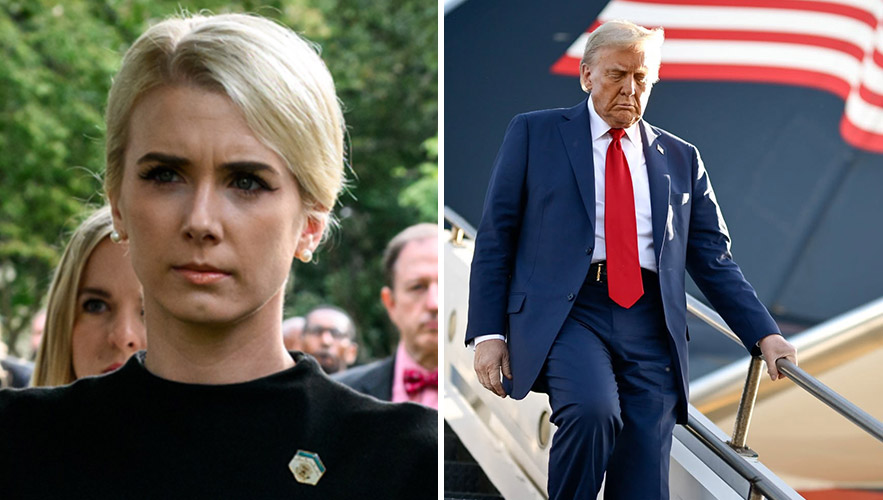
A former CIA officer says Natalie Harp’s extraordinary proximity to President Donald Trump creates an obvious counterintelligence target. The key distinction: reporting says Harp went more than a year without completing the routine White House clearance process, but the White House says she has since received a clearance.
Natalie Harp’s nickname, the “human printer,” once made her sound like an eccentric but relatively low stakes member of Donald Trump’s entourage. The latest scrutiny concerns something more consequential: how much access she has to the president, who can reach him through her, and how her security vetting reportedly unfolded after Trump returned to office.
Harp remains a special assistant to the president and executive assistant to the president. The White House’s July 2026 personnel report lists her in those roles at a salary of $150,000. Reporting from CBS News and other outlets describes her as a frequent presence at Trump’s side.

What the former officer warned
Marc Polymeropoulos, a former CIA operations officer, raised the counterintelligence concern during an Aug. 21 episode of Bulwark Takes. His argument was not that Harp has been shown to be working for a foreign government. No public evidence establishes that.
Instead, Polymeropoulos focused on what intelligence officers call access. Foreign services routinely study the people surrounding national leaders, looking for aides whose relationships, communications or devices could provide useful information or a pathway to the person at the center.
He said intelligence operations do not necessarily require recruiting an aide. They can include attempts to compromise phones, computers or other communications. Harp, he argued, has “access that a foreign adversary would only dream” of obtaining around a U.S. president.
That makes his warning an assessment of vulnerability rather than an allegation of betrayal. Polymeropoulos did not present evidence that Harp has been recruited, hacked or compromised. His point was that someone with her degree of proximity would predictably be interesting to foreign intelligence services.
He connected that concern to reporting about the delay in Harp’s security clearance, describing the combination of extraordinary access and incomplete vetting as a serious security issue.
Harp now has a clearance
The most important correction to some of the coverage is Harp’s current status.
MS NOW reported Aug. 19 that Harp repeatedly declined for more than a year to complete the routine security clearance process after joining the second Trump White House. The outlet cited people familiar with the matter and said her reasons for delaying the process were unknown.
According to that reporting, concerns developed among White House counsel and security officials before Trump personally intervened. Harp then completed the required paperwork, underwent the process and received a security clearance.
White House press secretary Karoline Leavitt confirmed the present tense point, telling Forbes that Harp “has a security clearance like everyone else” and describing her as a loyal, hardworking member of Trump’s team.
There is therefore no basis for saying Harp currently works at the White House without a clearance. The unresolved question concerns the earlier period: why the process reportedly remained unfinished for more than a year, and what controls governed her access during that time.
The public record also does not establish that Harp failed a background investigation, was formally denied a clearance or concealed a disqualifying fact. Her reported reluctance to complete the process and the reason for that reluctance remain separate questions.
Why presidential access matters
Not every federal employee requires a security clearance. The Office of Personnel Management explains that federal positions carry different requirements depending on the duties involved, ranging from basic credentialing and suitability reviews to national security determinations and eligibility to see classified information.
A clearance also does not automatically entitle a person to every government secret. Executive Order 12968 requires a separate need to know determination before an eligible employee receives classified information. Federal guidance similarly describes clearance as only one of the conditions for authorized access.
Those distinctions are important in Harp’s case because a period without clearance does not, by itself, prove she was improperly shown classified documents.
Counterintelligence risk can nevertheless extend beyond formal document access. A person constantly near a president can observe schedules, relationships, moods, meetings and communication patterns. Phones and computers may contain information valuable to an adversary even when it is not formally stamped classified.
An aide who acts as a gatekeeper can also reveal which people are trying to reach the president and when. Foreign intelligence services spend considerable effort mapping precisely those networks around political leaders.
That is why Polymeropoulos focused as much on Harp’s position as on her clearance history. From an intelligence perspective, a person does not have to possess a classified briefing book to become an attractive surveillance target.
Harp’s role extends beyond printing
Harp became widely known as Trump’s “human printer” because she supplied him with physical copies of articles, polling information and other material, including while traveling with him.
But reporting about her current role depicts something considerably broader.
New York Times White House correspondent Maggie Haberman has said Harp functions as a channel through which outsiders can reach Trump outside more conventional systems and through which Trump can contact people he wants to reach.
Haberman said that role extends, in some instances, to foreign leaders trying to contact the president. CNN transcripts of her interviews capture her description of Harp as a conduit for people seeking access to Trump when they cannot reach him another way.
Harp also handles substantial portions of Trump’s social media activity and is around him through much of the day, according to Haberman. Those duties help explain why the security clearance report attracted attention beyond ordinary White House personnel politics.
Acting as an executive assistant or gatekeeper is not inherently improper. Presidents have long depended on trusted aides to organize schedules, carry messages and manage communications. The concern here arises from the combination of unusually broad access and the reported delay in completing routine security vetting.
What security vetting does
National security background investigations are designed to assess whether a person can be trusted with sensitive responsibilities and information. The federal Standard Form 86 asks applicants to disclose extensive information relevant to that determination, including previous investigations and security clearance history.
Federal personnel security guidance describes the broader inquiry as an assessment of characteristics including reliability, trustworthiness and judgment. Depending on the position and investigation, authorities can examine matters such as foreign contacts, financial circumstances and other potential vulnerabilities.
Polymeropoulos emphasized that intrusive element when discussing his own CIA career. He said background investigators examined his finances, foreign contacts and personal history, arguing that such scrutiny is part of accepting a sensitive national security position.
A completed clearance still does not guarantee that a person cannot be manipulated or targeted. In a sense, cleared officials may be particularly attractive targets precisely because of what their jobs allow them to know.
The significance of the reported delay is therefore procedural. Vetting is intended to identify possible vulnerabilities before sensitive access is granted or expanded. Questions arise when an aide’s operational importance appears to develop faster than the review designed to assess those risks.
What the evidence does not show
The strongest claims in this story require careful boundaries.
There is no public evidence that Harp deliberately disclosed classified information, passed government secrets to a foreign contact, knowingly used a compromised device or acted on behalf of another government.
There also is no public evidence identifying a particular intelligence service that has successfully targeted her. Polymeropoulos was describing what he believes foreign services would want to do based on normal counterintelligence practice.
The reports that foreign leaders sometimes use Harp as a way to reach Trump are important because they demonstrate the breadth of her gatekeeping role if accurate. They do not, on their own, prove that those communications were illegal, secret or improper.
Nor should Harp’s unexplained delay in completing clearance paperwork be converted into evidence of a hidden motive. MS NOW reported that the reason was unknown. That uncertainty remains part of the story.
What is supported is narrower: a highly trusted presidential aide reportedly spent more than a year without completing a routine clearance process, despite extraordinary proximity to Trump, before eventually obtaining a clearance.
Scrutiny has moved beyond gossip
Public attention around Harp intensified after Democratic Sen. Jon Ossoff of Georgia referred to her during an Aug. 16 campaign rally while attacking Trump’s priorities.
The comment triggered aggressive responses from Trump allies and a wave of reporting about Harp’s close relationship with the president. Some Republicans and commentators accused critics of relying on sexist insinuations rather than examining her work.
Coverage then focused on personal letters Harp reportedly wrote to Trump and unusual stories from her years traveling with him. Those details may help explain why Trump trusts her, but they are not evidence of a national security violation.
CNN added another development on Aug. 22, reporting that a review of Harp’s deleted Twitter account found more than 150 posts from Jan. 6, 2021, including messages backing Trump and amplifying efforts to challenge the 2020 election result.
That reporting provides additional evidence of Harp’s long standing political loyalty. It does not establish that she poses a counterintelligence threat, and political beliefs alone should not be confused with proof of espionage or unauthorized disclosure.
Harp remains in Trump’s circle. There has been no announcement that she is leaving her current White House position, and the White House continues to defend her.
The unanswered security question
The more durable issue is not Harp’s portable printer, speculation about her personal relationship with Trump or reported tensions among White House personalities.
It is what happens when a single aide becomes an unusually important pathway to the president.
A gatekeeper can exert influence without making policy. The person can affect which messages reach a president, how quickly they arrive and who receives a response. That becomes especially significant when foreign officials reportedly recognize the aide as a useful route into the Oval Office.
From a counterintelligence perspective, that visibility has consequences. An adversary does not need to persuade an aide to betray the United States to gain something useful. Monitoring communications, exploiting an insecure device or simply studying patterns of access can itself produce intelligence.
Polymeropoulos’s warning is strongest when kept within those limits. He offered an experienced former intelligence officer’s assessment of why Harp’s position could attract targeting. He did not establish that a foreign service has successfully compromised her.
Meanwhile, the White House’s statement establishes that Harp now has a clearance but does not publicly explain the reported year plus delay before she completed the process.
That leaves a legitimate question for the administration: what safeguards governed Harp’s access during that earlier period, and why was someone with such extraordinary proximity to the president reportedly permitted to postpone routine vetting for so long?
Answering that question would require records and official explanations rather than speculation about Harp’s motives or personal life. For now, the available evidence supports concern about a reported vetting gap and the counterintelligence value of her position not a claim that Harp herself has been proven to be a security threat.
Leave a Reply