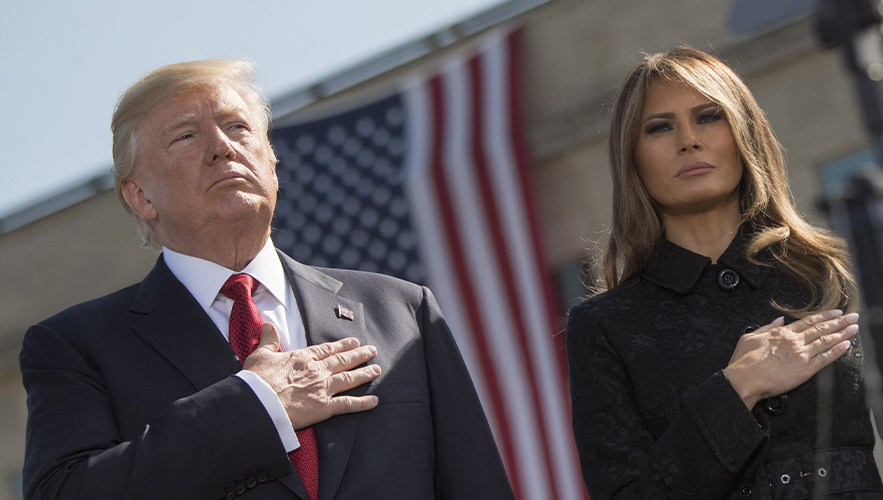
Video from the Aug. 23 race shows the first lady rise from her seat and, shortly afterward, presidential aide Natalie Harp approach Donald Trump. The sequence is visible, but the clip does not establish why Melania moved, what Harp said, or that the moments were connected.
A short video from Washington’s Freedom 250 Grand Prix has become the latest focal point for speculation about President Donald Trump, first lady Melania Trump and one of his most closely watched aides, Natalie Harp.
The footage from Sunday, Aug. 23, shows the Trumps seated together in a VIP viewing area. Melania Trump then gets up and leaves the immediate seating area. Harp, who had been positioned nearby with other members of the president’s entourage, subsequently approaches Trump briefly before moving away.
That chronology is visible. The motive is not. The clip does not establish that Melania Trump left because of Harp, that the first couple were arguing, or that Harp “demanded” the president’s attention. Those interpretations go beyond what the available footage establishes.
What the footage actually shows
The Freedom 250 brought Trump family members, Cabinet officials, senior White House aides and political allies into the same viewing area. The Independent reported that Harp sat several rows behind the president and first lady as the race began and was also seen talking with Eric Trump before the start.
Other footage and photographs from the event show Melania Trump sitting beside her husband while Harp remained only a short distance away. TMZ similarly reported that Harp was seated a few feet behind the first couple during the race.
But a few seconds of movement in a crowded spectator box cannot, on their own, establish anyone’s state of mind. The reporting circulating with the clip provides no verified audio explaining why Melania Trump stood up. It also does not establish that Harp’s later approach to the president caused, followed from or was otherwise related to the first lady’s departure.
That matters because the viral framing is stronger than the evidence. “Melania left her seat” is observable. Characterizing Harp as having demanded Trump’s attention requires an inference that the video itself does not substantiate.
Why Harp draws unusual attention
Harp is not simply another staffer who happened to appear behind the president. The New York Times reported that her formal titles are special assistant to the president and executive assistant to the president, and that she receives a $150,000 taxpayer-funded salary.
Her work is unusually close to Trump’s personal information flow. The Washington Post has described her as the aide known in Trump’s circle as the “human printer,” a reference to her habit of carrying printed articles, social-media posts and messages to him. The Post also reported that she routinely helps publish material on Trump’s Truth Social account.
Harp’s association with Trump predates his second White House term. She was a host at the conservative One America News Network from 2020 to 2022 and joined Trump’s political operation in 2022. She had earlier gained his attention after publicly crediting legislation he signed during his first term with helping her during cancer treatment.
That last claim has itself drawn scrutiny. The Washington Post reported that experts it consulted in 2020 said the drug Harp received was already FDA-approved and that the federal Right to Try law was unlikely to have affected her access to it.
The closeness of her day-to-day role means questions about Harp are not solely celebrity-style curiosity. An aide who helps determine what a president reads, sees and posts can exercise practical influence even without holding a Cabinet position or formal policymaking portfolio.
The letters intensified the story
Scrutiny accelerated after deeply personal letters attributed to Harp became public. The Daily Beast, working with Trump biographer Michael Wolff, published two letters it said Harp wrote to Trump in 2023. The New York Times separately reported viewing at least one letter from Harp.
In one, Harp told Trump, “You are all that matters to me,” and thanked him for being her “Guardian and Protector in this Life.” Another letter reflected on the period when she worked as a television host and expressed a desire to regain the personal rapport she said they once shared.
Those passages are striking because they are substantially more personal than ordinary workplace correspondence. They also help explain why otherwise routine scenes showing Harp near Trump have attracted unusual attention.
There is still an important verification boundary. CNN said it had not independently confirmed that Harp wrote or sent the two letters published by The Daily Beast. People likewise said it had not independently authenticated them. The Times’ separate report that it viewed one Harp letter adds corroboration for at least part of the correspondence, but it does not validate every interpretation attached to the documents.
If authentic, the letters document intense expressions of loyalty. They do not, by themselves, prove a romantic relationship, misconduct or any specific conflict involving Melania Trump.
Ossoff turned Harp into politics
The story moved from White House insider coverage into electoral politics after Sen. Jon Ossoff, the Georgia Democrat seeking reelection, invoked Harp during a campaign speech.
Ossoff accused Trump of neglecting presidential work and said he wanted to “build his ballroom and travel with Natalie,” a line that drew a strong response from the crowd and later from Trump’s allies.
The reference was tied partly to reporting that Harp was among a small group of aides who accompanied Trump during a covert plane switch in Turkey in July amid a potential Iranian assassination threat. The Washington Post reported that she was among the loyal, long-serving aides who moved with the president while some senior officials did not.
Ossoff’s phrasing also injected personal innuendo into what could otherwise be a debate about access, staffing and presidential decision-making. That distinction has shaped the backlash. Critics of Trump have focused on Harp’s unusual proximity and influence; Trump allies have argued that attention to her age, gender and presence around the president has crossed into sexist speculation.
The available reporting supports scrutiny of Harp’s official role and access. It does not support treating every suggestive interpretation about her relationship with Trump as established fact.
White House allies push back
The White House has publicly defended Harp. In statements reported by both The Washington Post and The New York Times, administration officials described her as one of the president’s “most loyal and hardest-working aides.”
Eric Trump also defended Harp after CNN interviewed her estranged brother, writing that she was deeply committed to his father, her job and the country. His comments addressed Harp’s character and work rather than resolving the authenticity or meaning of every reported letter.
At the Grand Prix itself, Sen. Bernie Moreno of Ohio told TMZ that scrutiny of Harp had become “super misogynistic.” Moreno argued that a male aide with similar access would not face the same speculation. He also acknowledged that he had not read the letters and did not know whether they were authentic.
His defense points to a broader evidence problem surrounding the story. Legitimate questions about who influences a president can coexist with unsupported assumptions about a female aide’s personal life. Responsible reporting has to separate those categories rather than treating them as interchangeable.
Melania had her own race-day role
Melania Trump’s presence at the Freedom 250 was not limited to sitting beside the president or appearing in viral clips.
She joined Trump for a ceremonial lap of the street circuit in the presidential limousine before the race. She also gave a Fox Sports interview in which she discussed a childhood interest in cars and racing that she associated with her father while growing up in Slovenia.
Her appearance came shortly after an expansion of her Fostering the Future initiative, which supports young people transitioning from foster care. People reported that a $2 million donation from IndyCar and Fox Corporation would support scholarships connected to the program at Indiana University and Purdue University.
Those details provide important context because they show that the first lady had her own public role and agenda at the event. A short clip of her standing up from a spectator seat therefore cannot reasonably be treated as self-explanatory evidence of a personal dispute.
The available footage establishes her movement. It does not explain her reason for moving.
The race was a major spectacle
The Freedom 250 itself was staged as part of celebrations marking the United States’ 250th anniversary. IndyCar listed the Washington event as Race 15 of the 2026 season, held Aug. 22 and 23.
The temporary course ran 1.7 miles through central Washington, with 25 drivers contesting a 147-lap, 250-mile race. Trump took a ceremonial lap in “The Beast” and waved the green flag to begin the competition.
Kyle Kirkwood won for Andretti Global, leading 128 of 147 laps and finishing 3.0906 seconds ahead of Christian Lundgaard. Will Power placed third. Championship leader Alex Palou endured a penalty and other setbacks before finishing 20th, reducing his points advantage with three races remaining.
The sporting result also supplies an important time marker for the political footage: the video came from a completed event on Aug. 23. Accounts written before the race that describe the Freedom 250 as still pending have therefore been superseded by the final result.
The event gathered a large cross-section of Trump’s political and personal circle in one place, making brief interactions among aides and family members inevitable. Harp’s presence remains notable because of her particular role, but her proximity alone does not establish what any individual conversation meant.
What remains unverified
The strongest factual account of the viral moment is also the narrowest. Melania Trump sat beside the president, stood up and left the immediate seating area. Harp, who was nearby, subsequently approached Trump briefly. That is the sequence described in the published account and visible in the circulated clip.
What remains unverified is more expansive: why Melania Trump left, what Harp said to the president, whether Trump summoned Harp, whether Harp initiated the exchange for a particular reason, and whether either interaction reflected tension involving the first lady.
Likewise, the public record supports describing Harp as an unusually close presidential aide whose reported correspondence contains intense expressions of loyalty. It does not establish a romantic relationship or a specific dispute between Harp and Melania Trump.
The difference is not semantic. It is the line between reporting an observable event and assigning a motive that the evidence does not prove.
For now, the Freedom 250 clip is significant less because it resolves questions about Trump’s inner circle than because it shows how quickly an existing controversy can shape the interpretation of an otherwise ambiguous moment. Harp’s access, the reported letters and Ossoff’s political attack are all part of the documented context. The reason Melania Trump stood up is not.
Leave a Reply