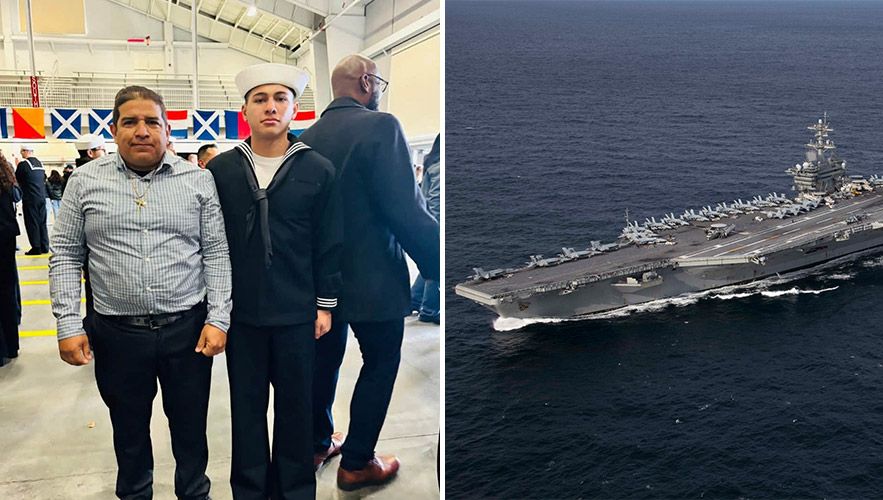
Luis Manuel Aviles Roa remains in ICE custody after a Key West traffic stop, even as his son’s carrier begins the long trip back to San Diego. The case exposes a widening gap between military-family immigration programs and the Trump administration’s tougher enforcement policy.
For months, Luis Manuel Aviles Roa had been waiting for one thing: the return of his son, Joshua, from an extraordinary deployment aboard the USS Abraham Lincoln. Instead, on Saturday, Aug. 22, federal immigration agents stopped Aviles in Key West, Florida, and took him into custody.
The arrest came just as the Lincoln was finally leaving the Middle East after nearly seven months in the region and more than nine months away from home. Joshua Aviles, a Navy sailor aboard the carrier, learned of his father’s detention while still at sea, turning what had been a long-awaited family reunion into an uncertain immigration fight.
The arrest came during a traffic stop
Aviles, 48, is a Nicaraguan native who has lived in the United States for about 19 years and works as a handyman in Key West, according to his family. His wife, Argelia Aviles, said he was headed to a mechanic when Border Patrol agents stopped him.
The Department of Homeland Security confirmed that Border Patrol arrested Aviles during a vehicle stop. DHS said he had entered the United States illegally and would remain in Immigration and Customs Enforcement custody while the government pursues removal proceedings.
Joshua Aviles said his father had a driver’s license, Social Security card and employment authorization, and that the family had been pursuing a green card for him. CBS News reported that DHS did not dispute the family’s statement that Aviles has no criminal record. Those facts, however, do not by themselves establish lawful immigration status.
DHS put its position plainly: “Having a family member in the military is not a free pass to violate our nation’s laws.” The statement reflects a broader enforcement approach adopted during President Donald Trump’s second term, under which military connections no longer carry the same practical protection from immigration enforcement that they often did under prior administrations.
A work permit is not legal status
One of the most important distinctions in Aviles’ case is also one of the easiest to misunderstand. A work permit can authorize a person to work in the United States without granting permanent residence or, by itself, resolving an underlying immigration violation.
The same is true of a Social Security number or state driver’s license. Those documents may be valid and legally issued while a person still has a complicated or unresolved immigration case. DHS told Telemundo in connection with Aviles’ detention that work authorization or a pending application does not itself confer lawful immigration status.
The family says Aviles had been waiting for approval of a green card application. Public reporting has not established the precise basis of that application, whether he had previously received military parole in place, whether he had an old removal order, or what other immigration history may affect his eligibility.
That means two claims can be true at the same time: Aviles may have possessed valid government-issued documents and a pending path toward permanent residence, while federal authorities may still contend that he is removable under immigration law.
Military parole in place still exists
The detention has drawn attention to military parole in place, a longstanding immigration tool designed for certain relatives of U.S. service members and veterans. The program remains available, but it is discretionary and does not guarantee a green card or immunity from immigration enforcement.
Under USCIS guidance, certain spouses, parents, sons and daughters of active-duty service members, selected reservists and qualifying veterans may request parole in place if they are in the United States without having been admitted. If granted, parole can help some applicants meet a procedural requirement needed to seek adjustment of status from inside the country.
The benefit is narrower than its name can suggest. Someone who entered lawfully and then overstayed generally is not eligible for parole in place on that basis because that person was already admitted. Other immigration barriers, including prior removal orders, criminal grounds or separate inadmissibility issues, may also require additional legal steps.
Congress has recognized the military-readiness rationale behind these policies: service members may be less able to focus on their missions when close family members face unresolved immigration problems. USCIS has historically treated military ties as a strong favorable factor in discretionary parole decisions, particularly when there are no serious adverse factors.
Enforcement policy changed in 2025
The most consequential change is not that military parole in place disappeared. It did not. The change is that immigration enforcement officials now operate under a different policy when deciding how much weight to give military service or military-family ties.
An ICE memorandum issued April 10, 2025, rescinded a 2022 directive governing consideration of U.S. military service during civil immigration enforcement. The replacement guidance says military service should still be identified and considered, but it also states that service “alone does not automatically exempt” a person from immigration consequences.
That shift matters because immigration law contains many forms of discretion. A person may be technically removable while also having a pending application, a U.S. citizen child, a military family connection or another factor that could historically have influenced whether ICE chose to arrest, detain or pursue removal at that moment.
Former immigration officials and military-law specialists interviewed by the Associated Press described the current approach as a major break from prior practice, including during Trump’s first term. DHS, by contrast, says the administration is enforcing laws passed by Congress and that military service does not create a separate exemption from those laws.
More military families are being detained
Aviles’ arrest is not an isolated case. An Associated Press investigation published earlier this month identified more than 50 parents and spouses of active-duty U.S. service members who had been detained since Trump returned to office. The AP found at least six had been deported and one had left the country voluntarily.
The government does not maintain a public count of such cases, so the AP’s tally was assembled from court records, news reports and interviews with relatives and attorneys. At the time of that review, at least eight immediate family members of service members remained in federal immigration custody, and the news organization said the true number could be higher.
The cases are not identical. DHS told the AP that some people in the group had previous removals, existing removal orders or convictions involving drunken driving or drugs. Others were reported to have no known criminal record and were detained while trying to resolve their status.
That variation is important. Military family membership does not erase an individual immigration history, and no single case proves how another should be resolved. But the growing number of detentions shows that family ties to active-duty troops are no longer functioning as the broad practical shield they once often provided.
Congress is scrutinizing the shift
The trend has begun to draw attention on Capitol Hill. More than 60 Democratic lawmakers asked DHS, the Defense Department and the Department of Veterans Affairs this month for information about deportations and detentions involving service members and their relatives.
The lawmakers argued that the policy could harm readiness by forcing troops to take leave, delay deployments or manage child-care crises when a spouse or parent is detained. They also questioned why some military recruiters continue to discuss immigration benefits available to service members’ relatives while enforcement agencies are detaining people who may be pursuing those benefits.
The Republican chairs of the Senate Armed Services and Veterans’ Affairs committees did not respond to AP requests for comment when the inquiry was announced. DHS has defended its enforcement policy, while the Pentagon has generally declined to comment on the broader findings involving military families.
The dispute is therefore not simply about whether military families receive an automatic legal exemption; they do not. It is about how much discretion the government should exercise when a service member’s immediate relative is trying to regularize status and what effect aggressive enforcement has on the service member’s ability to perform military duties.
The Lincoln deployment magnifies the strain
Joshua Aviles’ circumstances make that readiness argument unusually concrete. He said he had spent more than nine months deployed aboard the USS Abraham Lincoln and had been working shifts of more than 12 hours. The carrier’s deployment became a national story before his father was detained.
The Lincoln went more than 200 days without a port call, setting a modern-era U.S. Navy record and prompting complaints from families about food supplies, maintenance problems and mental-health strain. Defense Secretary Pete Hegseth has said accounts of conditions aboard the ship were “completely misrepresented,” while senior Navy leaders praised the crew’s performance under extraordinary operational demands.
By Aug. 22, the carrier had left the Middle East and moved into the U.S. 7th Fleet area as it began the trip back toward San Diego. The USS George Washington had arrived in the region to take over the carrier mission. That means Joshua’s deployment is finally moving toward its end, but the family crisis may not be.
In a Facebook post, Joshua said learning of the arrest left him struggling to focus while still working long hours at sea. His sister, Katherine Delgado, told the AP that Joshua had joined the military in part because he believed his service could improve his father’s prospects for obtaining lawful permanent residence.
The next steps are still uncertain
As of Monday, DHS said Aviles remained in ICE custody pending removal proceedings. No authoritative report had established that he had been released or that the government had carried out a deportation.
His legal options will depend on facts that have not yet been made public in detail: how he entered the United States, whether he has an existing removal order, what application is pending, whether he has received parole or another immigration benefit, and whether any other grounds of inadmissibility or relief apply.
For the family, the immediate question is simpler. Luis Aviles had expected to welcome his son home after one of the Navy’s most punishing recent deployments. Instead, Joshua is crossing back toward the United States while his father is in federal immigration custody, and there is no guarantee the two will be reunited when the sailor reaches home.
The case now sits at the intersection of two policies the federal government says are important: maintaining a military force ready for sustained overseas operations and enforcing immigration law without categorical exceptions. What happens to Aviles will show how those priorities are reconciled when they collide inside the same family.
Leave a Reply