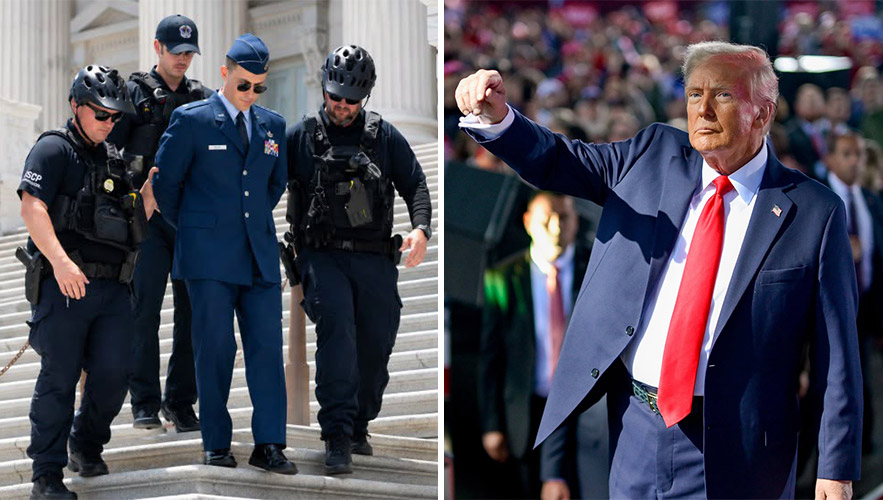
Air Force Maj. Jason Watson has been formally accused of contempt toward President Donald Trump, disobeying orders and conduct unbecoming an officer. The case is still at the charging stage, leaving the court martial forum, final allegations and any punishment unresolved.

An active duty Air Force major who publicly called for President Donald Trump’s impeachment now faces a military case that puts rarely used restrictions on officers’ political speech at the centre of a high profile dispute.
Maj. Jason Watson, 40, has served in the Air Force for 17 years. His defense announced Tuesday that the government had preferred charges under three articles of the Uniform Code of Military Justice, following his July 1 protest at the U.S. Capitol and an August television interview in which he again sharply criticized Trump.
What Watson has been charged with
Watson’s lawyers said the charging document contains three specifications under Article 88, five under Article 92 and two under Article 133. Article 88 prohibits commissioned officers from using “contemptuous words” against the president and several other senior civilian officials. Article 92 covers failures to obey lawful orders or regulations, while Article 133 addresses conduct unbecoming an officer.
The defense statement stressed that no allegation has been proven and that Watson is presumed innocent. CNN reported that the Article 88 specifications are tied to a June interview with the Defenders of Our Republic newsletter, Watson’s July 1 Capitol protest and his Aug. 17 appearance on CNN.
The Article 92 allegations go beyond the content of Watson’s criticism. According to CNN’s account of the charging document, prosecutors also accuse him of violating Defence Department political activity rules, wrongfully wearing his uniform at the Capitol event, violating leave requirements connected to his Washington trip and refusing an order to wear his uniform at work after the CNN appearance. The Article 133 specifications concern the Capitol protest and television interview.
The government is therefore not presenting the case as a single speech offense. It alleges separate acts under different military law theories, each of which would have to be supported by evidence if the case proceeds to trial.
Why Article 88 stands out
Article 88 is unusually visible because prosecutions under it are rare. The 2024 Manual for Courts Martial says the offense applies when a commissioned officer uses contemptuous words against a covered official and those words become known to someone else. It lists dismissal, forfeiture of all pay and allowances and up to one year of confinement as the maximum punishment for the offense itself.
CNN said its review found only two Article 88 convictions since the modern UCMJ took effect in 1951. One involved Army 2nd Lt. Henry Howe, whose conviction arose from a 1965 anti Vietnam War demonstration. Another came in 2021, when Marine Lt. Col. Stuart Scheler pleaded guilty to Article 88 and other offenses after publicly criticizing senior officials over the U.S. withdrawal from Afghanistan.
Watson’s attorney, Christopher Mutimer, has described the case as extraordinary and said he believes Watson is the first officer at the rank of major to be charged under Article 88. That is the defense lawyer’s characterization, not a finding by the Air Force or a court.
The protest that started the case
Watson’s public confrontation with military rules began July 1 on the House side of the Capitol. Wearing his Air Force uniform, he took part in an event organized by the Removal Coalition and held a sign calling for Trump’s impeachment, conviction and removal. Democratic Rep. Al Green of Texas initially accompanied him to the steps.
U.S. Capitol Police said members of the public generally may not demonstrate on the House steps unless accompanied by a member of Congress. After Green left, officers told Watson to stop demonstrating or face arrest. He did not leave, and police arrested him for crowding, obstructing and incommoding.
The arrest raised a second set of issues because Watson was an active duty officer participating publicly in uniform. Defense Department rules allow service members to hold personal political views and engage in some political activities, but active duty personnel face restrictions intended to prevent partisan activity from appearing to carry military endorsement.
DoD Directive 1344.10 permits active duty members to attend political events as spectators when they are not in uniform and no appearance of official sponsorship can reasonably be drawn. The directive bars several forms of active partisan participation and separately says commissioned officers may not use words prohibited by Article 88.
Another instruction says service members may not participate in certain off post demonstrations, including when they are on duty, when the activity breaches law and order, or when they are in uniform in violation of uniform regulations. Whether Watson’s conduct met the elements of the charged offenses remains a question for the military justice process.
His CNN interview changed the stakes
The controversy escalated after Watson appeared on CNN on Aug. 17. Asked why he knowingly risked his career by speaking out, Watson said Trump had “failed us” and accused the president of violating the Constitution and law, corruption and causing American deaths.
Watson also framed his actions as an attempt to encourage citizens who believed they were powerless. He said people did not have to be prominent or influential to act and said he wanted to draw attention to organizations calling for impeachment.
The next day, according to the Air Force account provided to CNN, Watson was ordered into pretrial confinement based on probable cause supporting allegations of continued misconduct. His defense said Tuesday that he remains confined.
Pretrial confinement is not a conviction or post trial punishment. Military rules treat it as restraint imposed before a case is resolved, subject to legal standards and review. The defence has said it intends to challenge Watson’s confinement as well as defend him against the charges.
Some alleged conduct occurred after Watson’s July arrest and after the Air Force announced an investigation, which could become relevant to claims that he disobeyed orders or continued prohibited conduct. The defense, meanwhile, emphasizes his stated belief that he acted from constitutional conviction rather than partisan loyalty.
What military speech rules allow
The case highlights a basic tension in military law: service members retain constitutional rights, but those rights operate within a system that gives unusual weight to discipline, command authority and the military’s nonpartisan role.
The Supreme Court has long recognized that the military is not governed by precisely the same speech rules as civilian society. In Parker v. Levy, the court said members of the armed forces are protected by the First Amendment while also recognizing that military law may regulate conduct left unregulated in civilian life.
Article 88 is one example. Its text applies to commissioned officers and protects specified civilian offices from contemptuous words. In the 1967 Howe case, the Court of Military Appeals rejected a First Amendment challenge after Howe carried signs attacking President Lyndon B. Johnson during an antiwar demonstration.
That precedent does not decide Watson’s case. Prosecutors would still need to prove the specifications, and the defense can contest whether particular words were legally contemptuous, whether orders were lawful, whether regulations applied as alleged and whether the evidence satisfies the required elements.
The broader rules are not a blanket ban on political thought. Active duty service members can vote, express personal opinions in permitted settings and take part in specified civic activities. Restrictions become tighter when military status, uniform, partisan advocacy, official authority or command obligations are involved.
The Air Force emphasizes neutrality
After Watson’s July arrest, Air Force Secretary Troy Meink emphasized that Airmen and Guardians are expected to comply with laws and policies governing conduct, political participation and use of the uniform. He said the service would investigate and allow commanders to determine an appropriate disposition under military law and due process.
The Air Force later told CNN that Watson is presumed innocent. It also said the Air Force District of Washington would oversee proceedings if the case is referred to a general court martial.
That “if” is central. Preferring charges is the formal act of making accusations under the UCMJ. Referral is a later decision that sends charges to a specified court martial for trial. The two steps are not interchangeable.
If authorities contemplate a general court martial, Article 32 of the UCMJ ordinarily requires a preliminary hearing before referral unless the hearing is validly waived. That proceeding considers whether the specifications allege offenses, whether probable cause exists, whether a court would have jurisdiction and what disposition is appropriate. Its recommendations are not a verdict.
Watson’s lawyer hopes others respond
Mutimer has not portrayed Watson’s actions as accidental or uninformed. In a statement released by his firm Tuesday, the lawyer said Watson acted with awareness that his career and liberty were at risk.
Mutimer also said he hoped Americans who feel powerless would take courage from Watson’s decision to speak and stand by his convictions. The statement reflects the defense’s effort to frame Watson’s conduct as a deliberate act of conscience rooted in his interpretation of his military oath and the Constitution.
That framing does not answer the legal questions. Military prosecutors can argue that personal motivation does not erase lawful restrictions on contemptuous speech, political participation, uniforms or obedience to orders. The defense can argue that the government has stretched those rules too far or failed to establish their elements in the circumstances alleged.
The central factual dispute may be less about whether Watson spoke — much of his conduct was public — than about how military law characterizes what he said and did, and whether each charged act can be proven beyond a reasonable doubt if it reaches trial.
What happens next
As of Aug. 25, the case remains in its pretrial phase. Watson has been charged and remains in pretrial confinement, but no court martial has found him guilty, and public reporting has not established that the charges have been referred for trial.
The next major developments could include review of his confinement, an Article 32 preliminary hearing if a general court martial is pursued, a referral decision, changes to the specifications or another form of disposition. Until those steps occur, predictions about a final sentence, dismissal from the Air Force or loss of retirement benefits remain contingent.
For Watson, the stakes are substantial. Seventeen years into an Air Force career, he has publicly accepted the possibility that his protest could end his service. His lawyer is now presenting that willingness as part of the message Watson wanted to send.
For the military, the case raises a different question: how to enforce rules meant to preserve discipline and political neutrality when an officer intentionally uses his uniform, rank and public platform to challenge the commander in chief. The answer will depend on the charges the Air Force ultimately refers and what military prosecutors can prove.
Leave a Reply