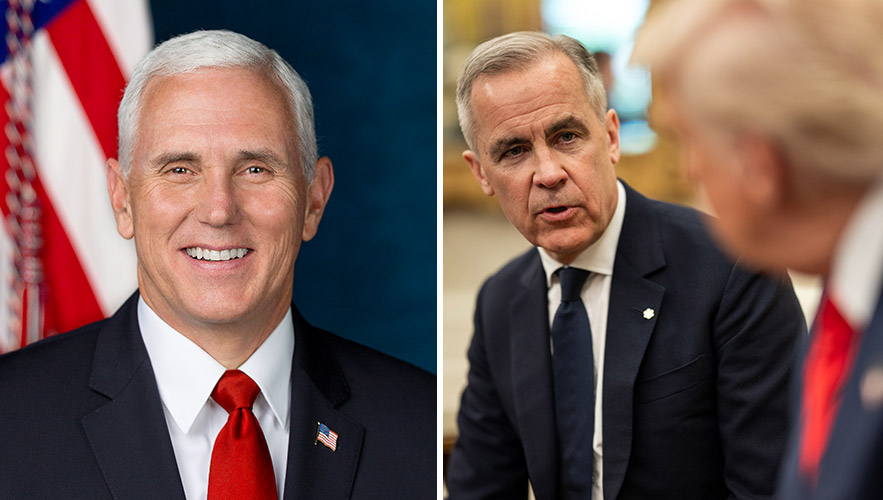
Former Vice President Mike Pence is urging President Donald Trump to avoid a prolonged trade war with Canada after new 50% U.S. tariffs took effect. His warning lands as inflation remains elevated and Canada prepares its own retaliatory duties for September.
Former Vice President Mike Pence warned Sunday that the renewed U.S.-Canada trade fight could aggravate cost pressures for American families, breaking with President Donald Trump’s tariff strategy as a fresh round of import taxes took effect over the weekend.
Speaking from Kyiv on CNN’s State of the Union, Pence said Americans were already focused on affordability and added that “the last thing we need right now, as our economy is getting back on its feet, is a trade war with Canada.” The dispute is no longer hypothetical: 50% U.S. tariffs on roughly $20 billion of Canadian goods took effect Saturday after last-minute negotiations collapsed.
What Pence is warning about
Pence’s criticism rests on a basic feature of tariffs: the U.S. government collects them from importers bringing covered goods into the country. What happens afterward varies. Importers can absorb some of the cost, suppliers can cut prices, companies can shift sourcing, or businesses can pass part of the increase to customers.
That is why a 50% tariff does not automatically translate into a 50% increase at the cash register. But it can still create upward pressure on prices, especially when businesses have few substitutes or when Canadian goods are embedded in supply chains that serve U.S. manufacturers and retailers.
Federal Reserve research published this year found that tariffs imposed in 2025 raised prices most in categories with greater tariff exposure. One June Fed paper estimated 15% to 20% price pass-through in the categories it studied and found that households reduced spending as tariff exposure increased. Those estimates concern earlier tariffs, not the new Canada duties, so they do not establish the size of any future price effect from this weekend’s measures.
Pence has opposed broad tariff increases since Trump’s second term. On CNN, he argued for a different approach: negotiate aggressively, but preserve freer trade with close allies. His remarks are notable because he served as Trump’s vice president during the first-term negotiation of the U.S.-Mexico-Canada Agreement.
What took effect Saturday
The new U.S. measures come from three proclamations Trump signed July 20 under Section 338 of the Tariff Act of 1930. The White House said the measures impose additional 50% tariffs on selected Canadian products in response to what the administration calls discriminatory Canadian treatment of U.S. alcohol, dairy products and motor vehicles.
The covered goods range from wine and other consumer products to hockey equipment and cement. The White House said the duties apply even when a covered product otherwise qualifies for preferential treatment under the U.S.-Mexico-Canada Agreement. Energy, potash, some fish and critical minerals, and goods already subject to certain Section 232 tariffs are among the exclusions.
Trump initially set the duties to begin in August, then delayed the effective date by three days while negotiators tried to reach a compromise. That pause expired at 12:01 a.m. Eastern time Saturday, August 22.
The Associated Press reported that the new duties cover about $20 billion in Canadian goods, roughly 5% of Canada’s annual exports to the United States. That makes the new tariff round narrower than an across-the-board tax on all Canadian imports, but still significant enough to hit specific companies, retailers and consumers.
Why the talks collapsed
The two governments offer sharply different accounts of why the negotiations failed.
Canadian Prime Minister Mark Carney said Ottawa had been prepared to eliminate remaining retaliatory tariffs on strategic sectors such as steel, aluminum and autos if the United States substantially reduced its own duties. He also said Canada was willing to encourage provinces to restore U.S. alcohol sales and consider administrative steps involving dairy supply management.
Carney said the U.S. then introduced last-minute terms that Canada considered economically unacceptable and intrusive on Canadian sovereignty, including demands affecting vehicle tariff relief and Canada’s ability to make trade arrangements with other countries. Summing up his view, Carney said Washington “asked too much and offered too little.”
U.S. Trade Representative Jamieson Greer disputed that account. He said Canada had made new demands, retreated from earlier commitments and chosen retaliation instead of accepting what the administration regarded as favorable tariff reductions. The Trump administration has argued that the new duties are intended to counter Canadian barriers and protect U.S. workers and supply chains.
The result is that there is no agreement and, for now, no announced timetable for another round of talks. AP reported Saturday that no further negotiations were planned.
Canada is preparing retaliation
Carney said Canada will match the new U.S. tariffs “dollar for dollar,” with the countermeasures scheduled to take effect September 8, the Tuesday after Labor Day. Ottawa has not yet published the complete product list.
He said the retaliation will concentrate on sectors including steel, dairy, appliances, agricultural equipment, pulp and paper, and electronics. Canada also plans support for industries and workers exposed to U.S. tariffs.
That timing creates a short window for diplomacy before the dispute becomes more expensive in both directions. U.S. tariffs are already being collected, while Canada’s next round is still pending. If the two sides find an off-ramp before September 8, some of the additional economic damage could be limited. If they do not, U.S. exporters will face new barriers in one of their largest foreign markets.
Carney acknowledged that retaliation itself carries a cost. In his August 22 remarks, he said the measures would raise prices and reduce choice for Canadians. That admission reflects the broader trade-off in retaliatory tariffs: they can pressure the other government while also imposing costs at home.
Why affordability is a live issue
Pence tied the trade dispute directly to affordability at a time when recent U.S. data show households are still dealing with elevated prices and a softer labor market.
The Consumer Price Index rose 3.4% over the 12 months through July, according to the Bureau of Labor Statistics. Food prices were up 3.0%, shelter was up 3.2% and energy was up 14.7%. Gasoline prices were 24.6% higher than a year earlier, even though energy prices fell in July itself.
The labor picture has also lost momentum. U.S. nonfarm payroll employment fell by 23,000 in July, while the unemployment rate was 4.1%. The government also revised May and June job growth lower by a combined 103,000 jobs.
The broader economy is still growing, but at a slower pace. The Bureau of Economic Analysis estimated that real gross domestic product increased at a 1.5% annual rate in the second quarter, down from 2.1% in the first quarter. A revised second-quarter estimate is due August 26.
None of those figures proves the new Canada tariffs will materially worsen inflation or trigger a downturn. They do explain why the risk of additional price pressure has become politically sensitive.
The economic stakes go beyond shopping
The U.S.-Canada relationship is unusually integrated. The two countries sold each other about $880 billion in goods and services last year, according to the Associated Press, and cross-border supply chains connect industries ranging from autos and machinery to agriculture, energy and consumer products.
That integration means tariff effects can travel through several layers before reaching a household. A tariffed Canadian input may first raise costs for a U.S. manufacturer. The manufacturer may absorb the cost, raise wholesale prices, switch suppliers or alter production. Retail prices can then change later, sometimes gradually rather than immediately.
Federal Reserve researchers have documented that pattern in earlier tariff episodes. An April Fed analysis concluded that tariff changes made in 2025 had pushed up core goods prices, with the effects building over several months. A separate March study found retail price pressure developed gradually rather than appearing as a single jump.
Retaliation adds a second channel. Canadian tariffs can make U.S. products more expensive in Canada and reduce demand for American exports. That can hurt producers even when they do not directly import Canadian goods.
The fight tests Trump’s trade strategy
Trump has made tariffs a central economic tool, arguing that they can protect domestic industries, force trading partners to change policies and encourage investment in U.S. production. The White House says the Canada measures are designed to address unequal treatment of American alcohol, dairy and automotive exports.
The legal path is also unusual. After the Supreme Court in February rejected Trump’s use of emergency economic powers for a large portion of his earlier tariff program, the administration turned to other statutes. For the Canada measures, Trump invoked Section 338, a rarely used provision allowing tariffs of up to 50% against a country found to discriminate against U.S. commerce.
The new duties therefore serve two purposes for the administration: they are leverage in a specific dispute with Canada and a test of an alternative legal foundation for Trump’s broader tariff agenda.
For businesses, however, the legal theory is only one part of the calculation. Companies also have to decide whether the tariffs will remain in place long enough to justify changing suppliers, renegotiating contracts or moving production.
What happens next
The immediate deadline is September 8, when Canada says its retaliatory tariffs will begin. Before then, both governments could restart negotiations, modify the tariff lists or offer temporary relief, but neither side has announced a new round of talks.
Pence’s intervention adds a prominent Republican voice to pressure for a negotiated settlement. His position is not that the United States should avoid hard bargaining with Canada. It is that leverage should be used to reach freer trade rather than normalize an escalating tariff exchange.
For American families, the most important question is not the rhetoric on either side of the border but how long the tariffs last, how broadly retaliation spreads and how much of the added cost businesses pass through.
The new 50% duties have only just taken effect, so their specific impact on U.S. consumer prices cannot yet be measured. What is already clear is that a dispute between two deeply connected trading partners has moved from threat to implementation, while Canada’s next response is scheduled and no new negotiating track has been announced.
That makes Pence’s affordability warning a forward-looking judgment, not a measured outcome. The economic evidence from earlier tariff rounds shows that import taxes can raise consumer-goods prices, but the scale of this episode will depend on its duration, product coverage, business responses and whether Washington and Ottawa find an off-ramp before retaliation widens the fight.
Leave a Reply