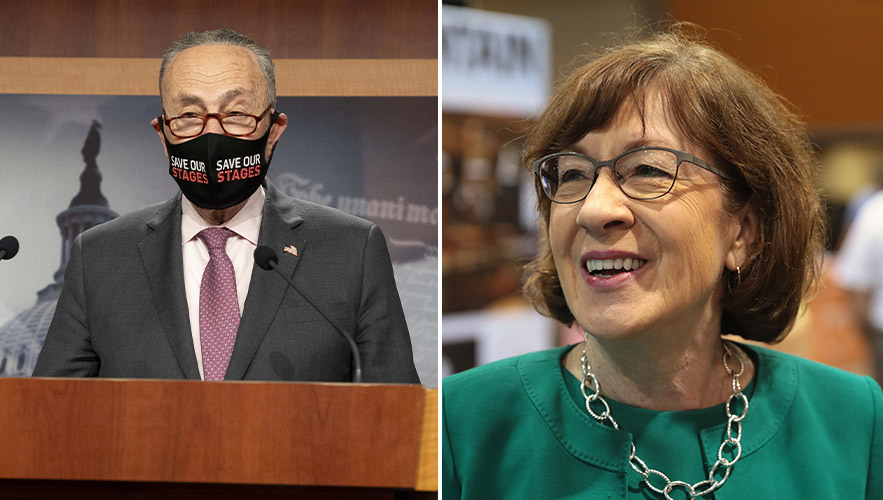
Democrats still need a net gain of four seats to control the Senate in 2027, an unforgiving target. But a late-summer expansion of the battleground into Iowa, Texas and Alaska has created more plausible pickup routes than the party appeared to have earlier in the cycle.
The fight for the Senate is no longer confined to a handful of familiar swing states. With the November 3 election approaching, Democrats are trying to defend vulnerable seats in Michigan, Georgia and New Hampshire while challenging Republicans across a wider stretch of the map.
That expansion is the main reason the majority remains genuinely in play. The Cook Political Report moved Iowa and Texas into its toss-up category on August 20, leaving six Senate contests rated toss-ups: Alaska, Iowa, Maine, Michigan, Ohio and Texas. Five of those seats are Republican-held; Michigan is the lone Democratic-held seat in that group.
The four-seat math remains harsh
Republicans currently hold 53 Senate seats. Democrats hold 45, while two independents caucus with them, giving the Democratic side 47 seats for organizational purposes. Because Democrats must get beyond a 50-50 split under a Republican administration, they need to reach 51 seats — a net gain of four.
Defense is therefore as important as offense. If Democrats retain every seat they already control or caucus with, they need four Republican-held seats. North Carolina, where Republican Sen. Thom Tillis is retiring, is central to that equation because Cook currently rates the open race Lean Democratic.
If former Democratic Gov. Roy Cooper wins North Carolina, Democrats would still need three more Republican-held seats while protecting Michigan, Georgia and New Hampshire. Maine, Ohio and Alaska are obvious targets, but Iowa and Texas now provide alternatives. A loss in Michigan would raise the price to five Republican pickups.
That arithmetic explains why the wider map matters. It does not make Democrats’ target smaller. It gives them more possible combinations for getting there.
Maine is still a pivotal target
Maine remains one of Democrats’ clearest opportunities to defeat a Republican incumbent, but the race was disrupted in July when Graham Platner, who had won the Democratic primary, withdrew after a sexual-assault allegation that he denied. The state party then overwhelmingly selected former Maine Senate President Troy Jackson as its replacement nominee.
Jackson, a longtime legislator and former logger from northern Maine, now faces Sen. Susan Collins, who has represented the state in the Senate since 1997. A Fox News poll conducted August 12 showed Jackson at 48% and Collins at 46%, while a July University of New Hampshire survey also put Jackson ahead by three points.
Those margins are narrow, and Collins has outperformed polling before. In 2020, she won reelection by more than eight points after many surveys suggested a much closer contest. Her campaign is again emphasizing her seniority and her role as chair of the Senate Appropriations Committee.
For Democrats, the case for Jackson is now rooted in his state-level experience and labor background. The party needs him to keep the campaign centered on economics and Collins’s record rather than the controversies that consumed Platner’s candidacy.
Michigan is the key Democratic defense
Michigan is the toss-up Democrats can least afford to lose. The seat is open because Democratic Sen. Gary Peters is retiring, and former public-health official Abdul El-Sayed narrowly defeated Rep. Haley Stevens in the August 4 Democratic primary.
El-Sayed won 48.48% to Stevens’s 47.51%, overcoming a large spending disadvantage and opposition from much of the party establishment. He now faces Republican Mike Rogers, a former House Intelligence Committee chairman who also ran for Senate in 2024.
The contest creates a different problem from Maine. In Michigan, Democrats are defending a seat they already have. Every Democratic loss changes the national arithmetic before any pickup is counted.
Republicans are expected to portray El-Sayed as too progressive for a closely divided state, focusing in part on positions including Medicare for All and his approach to U.S. policy toward Israel. El-Sayed, meanwhile, is trying to convert the movement energy that carried him through the primary into a broader general-election coalition.
Cook still rates Michigan a toss-up. A Rogers victory would force Democrats to compensate by winning an additional Republican-held seat somewhere else.
North Carolina and Georgia help
Two Southern states have become stabilizers for Democrats rather than the liabilities many expected at the start of the cycle.
In North Carolina, Cooper has led former Republican National Committee chairman Michael Whatley in a series of public surveys. An Elon University poll released August 12 found Cooper ahead 53% to 42% among likely voters. A Carolina Journal survey conducted August 9-10 showed Cooper at 51.5% and Whatley at 39%.
Polling is not a forecast, but the pattern has been consistent enough for Cook to rate the seat Lean Democratic. Because the seat is Republican-held, a Cooper victory would provide one of the four net pickups Democrats need.
Georgia has moved from a top Republican opportunity toward a seat Democrats currently appear better positioned to defend. Sen. Jon Ossoff faces Republican Rep. Mike Collins and reported more than $42 million in cash on hand after raising about $20 million in the second quarter. Collins reported roughly $2.2 million on hand.
Cook rates Georgia Lean Democratic. The state remains competitive, but as long as Ossoff holds an advantage, Republicans have fewer obvious places to offset Democratic gains elsewhere.
Alaska and Ohio widen the map
Alaska produced one of the most striking late-summer results. In the August 18 open primary, former Democratic Rep. Mary Peltola finished first with about 48% of the vote, while Republican Sen. Dan Sullivan was second with roughly 43% in results reported by the Associated Press.
The result does not mean Peltola is favored in November. Alaska uses a top-four system followed by ranked-choice voting, so the general election includes additional candidates and a different electorate. Still, finishing ahead of a two-term incumbent showed that Peltola is a serious challenger in a state Republicans ordinarily expect to hold.
Ohio offers another possible route. Former Democratic Sen. Sherrod Brown is trying to return to the chamber in a special election against Republican Sen. Jon Husted, who was appointed to the seat vacated when JD Vance became vice president. Public polling has been close, and Cook rates the race a toss-up.
Brown lost his other Ohio Senate seat in 2024, when Republican Bernie Moreno defeated him. His 2026 campaign tests whether a Democrat with a strong personal brand can run ahead of the national party in a state that has shifted Republican in presidential elections.
Iowa and Texas change the strategy
The August 20 Cook ratings shift was significant because Iowa and Texas had previously been treated as Republican-leaning races. Cook moved both to toss-up status, saying public and private polling had become too competitive to justify a Republican advantage.
In Iowa, Republican Rep. Ashley Hinson faces Democratic state Rep. Josh Turek for the open seat being vacated by Sen. Joni Ernst. An early-August Emerson College poll had Hinson ahead 48% to 45%, while other surveys have shown a tighter race. Iowa has not elected a Democratic senator since 2008.
Texas is similarly difficult by historical standards. Republican Attorney General Ken Paxton faces Democratic state Rep. James Talarico for the open seat. Recent surveys have repeatedly shown the contest within a few points, with some giving Talarico a narrow advantage and an August 9-10 Emerson poll putting Paxton ahead by one.
No Democrat has won a Texas Senate race since 1988. That remains an important baseline. But national handicappers now view both Texas and Iowa as competitive enough that Republicans cannot assume those seats will stay out of the fight.
The national climate favors competition
The broader environment is giving Democrats reasons to believe redder states can be competitive. A Pew Research Center survey conducted July 6-12 found Democrats leading Republicans 43% to 37% among registered voters on the generic congressional ballot.
Pew also found an engagement gap. Seventy percent of Democrats and Democratic-leaning independents said it “really matters” which party controls Congress, compared with 60% of Republicans and Republican leaners. Thirty-nine percent of Democrats said they had thought a lot about the midterms, versus 22% of Republicans.
President Donald Trump is another factor. Pew measured his job approval at 34%, with 64% disapproving. Among registered voters, 42% said they viewed their congressional vote as a vote against Trump, while 22% saw it as a vote for him.
Economic dissatisfaction is reinforcing that pressure. Only 24% of Americans in the Pew survey rated national economic conditions excellent or good, and 60% said Trump’s economic policies had made conditions worse. Concern about gasoline prices rose sharply from January.
The administration this week moved to end summer-blend gasoline requirements early as pump prices remained elevated during the Iran war. Reuters reported the national average at about $4.10 a gallon, compared with $3.13 a year earlier, illustrating how foreign-policy developments have fed directly into a cost-of-living issue voters can see every time they fill a tank.
Republicans have a counterargument to that national mood. Their strongest candidates can run on state-specific records rather than on Trump alone, and GOP strategists expect the party’s financial network to spend heavily once the fall campaign fully engages. They also argue that Democratic nominees can be defined by positions less popular than the party’s economic message.
The absence of Trump from the ballot cuts both ways. It may reduce participation among some infrequent voters who turn out primarily for him, but it also gives Republican Senate candidates more space to establish political identities distinct from the president.
Those national indicators do not determine Senate outcomes. Candidate quality, state partisanship, turnout and late events still matter. But they help explain why states Trump won comfortably in 2024 are now being treated as competitive.
The majority still requires near perfection
The most favorable Democratic scenario is straightforward and difficult: hold Michigan, Georgia and New Hampshire; win North Carolina; then take three more Republican-held seats from Maine, Ohio, Alaska, Iowa and Texas.
Lose Michigan, and Democrats would need North Carolina plus four of those five Republican toss-ups. Lose Georgia or New Hampshire as well, and the number of required pickups rises again.
New Hampshire remains worth watching even though Cook rates it Lean Democratic. Democratic Rep. Chris Pappas is positioned for the nomination, while former Sen. John Sununu is the leading Republican contender ahead of the September 8 primary. A late-August RealClearPolitics average showed Pappas ahead of Sununu by 3.3 points.
The Senate contest is therefore balanced between two realities. Republicans begin with the structural advantage of a 53-seat majority and can afford to lose some ground. Democrats now have more credible targets than they did earlier in the cycle and a national environment that has made several normally Republican states competitive.
That is why the Senate is still within reach for Democrats — and why “within reach” should not be confused with “likely.” Their path is broader, but it still depends on holding nearly every vulnerable seat they already have while winning multiple races on Republican terrain.
Leave a Reply